Data Pipeline Validation
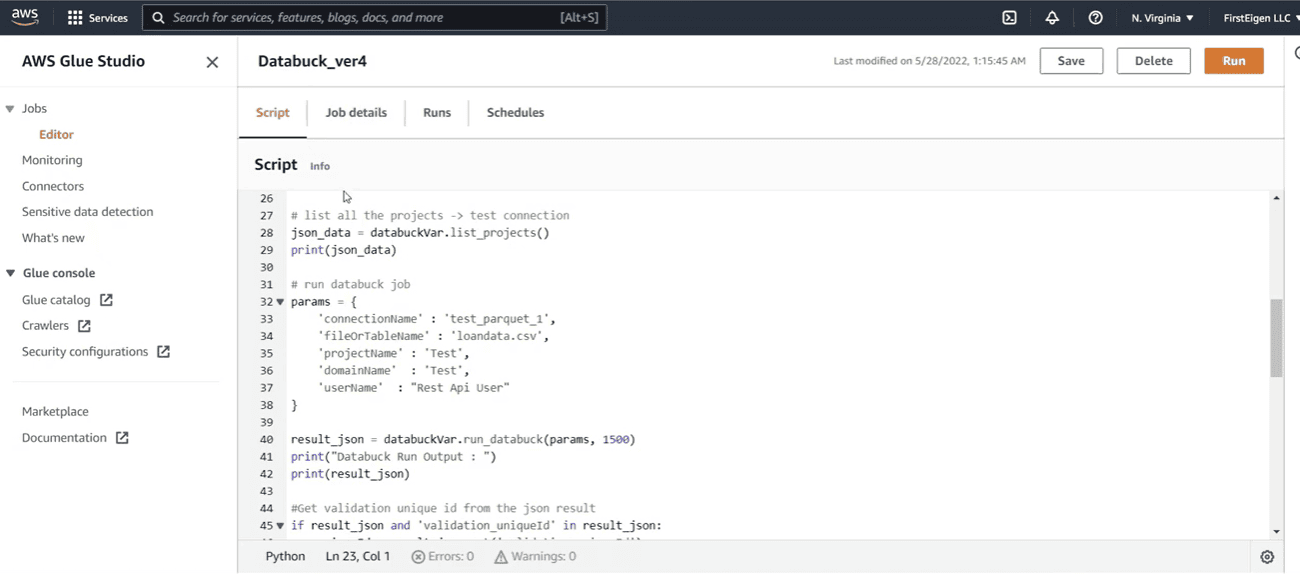
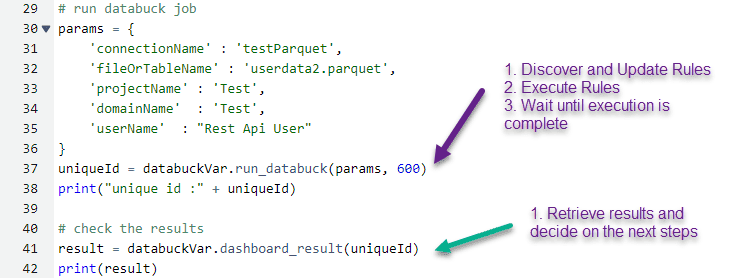
Automated Data Validation Tool embedded into Your ETL Pipeline with
Just 3 Lines of Code
Call DataBuck directly from your ETL code to validate data before it moves into warehouses, dashboards, reports or AI workflows.
Trusted by the World’s Leading Enterprises






The Hidden Risk
Your Pipeline Can Succeed While Your Data Fails
A successful run confirms jobs ran and files landed — not that the data is
accurate, complete, reconciled, or fit for use.
Bad data still moves forward when:
VS

DataBuck
tells you whether the data should move.
Why Automate
Benefits of Automated Data Validation
The more data your business runs on, the more you gain from automating validation. Here's what enterprise teams unlock.
Validate 1000s of datasets / second
Manual checks take minutes per record — DataBuck clears thousands in seconds, and the gap only grows with your data volume.
Detect 14+ data error types automatically
Static rule-based checks miss issues in dynamic, connected data. DataBuck, an automated data validation tool, evolves with your data to trap far more errors, with built-in root cause analysis to pinpoint why they happened.
Cut manual effort by 90%
Automation handles the tedious validation, so you can redeploy people to higher-value work.
Reduce costs by 50%
Less manual work lowers labor costs while more accurate data cuts downstream waste — so automation pays for itself.
Enterprise-Ready
Built for Enterprise-Scale Data Validation
Everything you need to trust the data flowing through your pipeline — fast,
secure, and economical.
100M
records validated in 60 seconds
Powered by agentic AI.
Scalable
Set up 1,000 data assets in less than 40 hours.
Better
Uses no-code ML for auto-detection of 14 types of data errors.
Economical
Validate 10,000 data assets in less than $50.
Secure
No data leaves your data platform.
Integrable
Works with data pipeline, governance, alert, and ticketing systems.
In Your Stack
What DataBuck Adds to Your ETL/ELT Stack
AI-powered autonomous ETL validation gate that sits inside your existing data
pipeline, from in-job checks to trust scores, audit trails, and enterprise security.
Use one validation pattern across your stack
Apply the same validation call in Python, Spark, SQL, dbt, or Airflow — one consistent pattern everywhere your data moves.
Auto-discovered, auto-updated rules
AI-powered data validation learns from your data patterns and business context so rules adapt as schemas or logic changes.
Cross-platform reconciliation
Match data across platforms for migration and source-to-target use cases, confirming nothing is lost or altered in transit.
Data trust scores
Data trustability solutions provide ongoing trust scores and trustability views, giving the business continuous confidence in the data it depends on.
Audit trails and clear dashboards
Stakeholder-friendly dashboards and complete audit trails including failure rates and historical trends.
Enterprise security and integrations
Enterprise-grade security with integrations across cloud, on-prem, and the incident channels your teams already use.
How It Works
How DataBuck Validates ETL Pipeline Data
DataBuck is an autonomous data validation tool built to validate data before it moves downstream.
Pass
Load to Snowflake, Databricks, BigQuery, Redshift
Dashboards, reports, workflows
Warn or review
Quarantine or approval path
Fail
Block downstream publish
What Customers Are Saying About Us


First Eigen has helped us tremendously with our sales attribution. Their data solutions are precise and consistent, and the team is great to work with. The confidence we have in First Eigen's data solutions has allowed us to focus on other areas of our business. We highly recommend First Eigen to any organization looking to elevate their data accuracy and performance.

DataBuck has been instrumental in ensuring data quality on our Hadoop platform. Its automated profiling and validation features make it easy to identify issues quickly and maintain trust in our data, and the user-friendly interface and flexible rule engine greatly accelerates data quality initiatives. I would highly recommend DataBuck for any organization looking to strengthen their data quality processes.

DataBuck by FirstEigen is a powerful, ML-driven data quality tool that not only automated complex validation tasks at scale but also integrated seamlessly with our GCP environment, significantly improving data trust while reducing manual effort by 50%.

DataBuck's automated data quality validation capability was used to validate sales data of the US Commercial operations. Its DQ rules recommendation engine can significantly reduce manual data validation efforts, improve issue detection, and enhance confidence in downstream analytics and reporting. DataBuck's scalability and improved transparency to data trust make it a valuable asset in any complex data environment.
Deployment
Run DataBuck Where Your Data Already Flows
Inside ETL/ELT Jobs
Automate data pipeline validation with DataBuck from AWS Glue, Databricks, Talend, DBT, Fivetran, Matillion, Informatica, or any tool that supports REST API / Python.
Through Enterprise Schedulers
Run validations through existing schedulers enabling data pipeline automation with Autosys or orchestration platforms already used by your data teams.
From DataBuck's Built-In Scheduler
Schedule recurring checks directly inside DataBuck when a pipeline-level code call is not required.
Across Cloud, On-Prem, and Hybrid Environments
Use DataBuck across modern and legacy data environments, including warehouses, lakehouses, databases, files, and enterprise platforms.
Stop bad data before it moves
Validate every dataset in your ETL path — before it reaches a warehouse, dashboard, or AI workflow.
Comparison
How DataBuck Compares
Here's how Databuck's approach differs from code-centric testing frameworks
and data observability platform
| Capability |
DataBuck AI-driven data validation Tool | Legacy DQ Tools Rule-based, manual | Manual / In-House Scripts & SQL |
|---|---|---|---|
| Main purpose | Test expected data conditions | Test expected data conditions | Monitor incidents and anomalies |
| AI-powered no-code ML | Auto-discovers 1000+ validation rules and thresholds with no-code ML — no manual authoring | Manually authored expectations in code | Configured monitors and metrics |
| Business context aware | Learns each dataset's patterns and business context to adapt checks automatically | Static rules with no built-in context | Detects anomalies with limited business context |
| Pipeline control | Returns clear data pipeline validation decisions your pipeline can use to proceed, block, quarantine, or review. | Possible with custom gating | Often alert-first, control requires setup |
| Trust scoring | Built-in file, table, and dimension-level trust scores | Usually not core | Usually focused on alerts and health signals |
| Reconciliation | Built-in cross-system validation | Requires custom logic | May provide lineage/context, not always reconciliation |
Comparison reflects common approaches to data quality and is intended as general guidance, not a feature-by-feature audit of any specific product.
Use Cases
Where Data Pipeline Validation Matters Most
Warehouse and Lakehouse Loads
Validate data before it enters Snowflake, Databricks, BigQuery, Redshift, or Delta Lake.
Cloud Migration Validation
Reconcile source and target systems during migration to confirm data was not lost, duplicated, or altered.
Financial and Regulatory Reporting
Stop incomplete, inaccurate, or unreconciled data before it reaches reporting workflows.
AI and Analytics Readiness
Use AI data validation before data reaches AI models, copilots, agents, dashboards, or decision systems.
Source-to-Target Reconciliation
Compare counts, values, keys, totals, and business rules across systems before downstream use.
Answers
Frequently Asked Questions
Everything you need to know about authenticating your data pipeline.