

Arif Mujawar
Principal Solutions Architect
What Do Failed AI Projects Have in Common?
Most AI failures are not model failures — they are data, governance, operational trust, and weak AI-ready foundations.
“AI alone is not the solution – trusted, validated, continuously governed data is the foundation of every successful AI and Agentic AI system.”
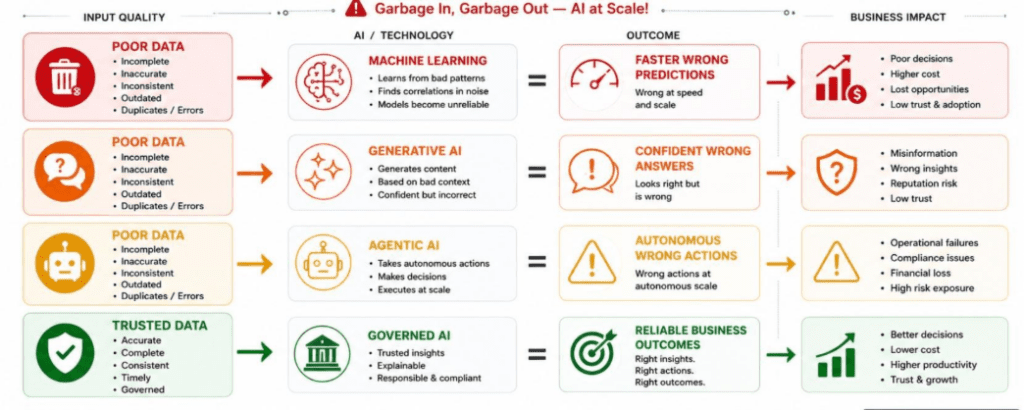
Organizations are rapidly adopting Generative AI and Agentic AI, but many AI initiatives fail in production. One of the most common reasons why AI projects fail is the lack of trusted, governed, and business-ready data.
The common pattern behind failed AI projects is not weak AI models. It is poor data quality, weak governance, missing observability, and a lack of operational trust. Organizations often struggle to measure trust consistently, which is why a data trust score can help evaluate data readiness for AI initiatives.
In the Agentic AI era, this risk becomes much larger because AI systems are not only generating answers — they are triggering autonomous business actions.
“Most companies can copy AI tools, but very few can build trusted data foundations – and that is where the real long-term value is.”
Why AI Projects Fail at Scale
Bad data does not become intelligence after adding Machine Learning, AI, Generative AI, or Agentic AI. AI only makes the output faster, shinier, more scalable, and more autonomous.
The enterprise AI failure rate remains high because organizations often focus on AI models before establishing strong data foundations, governance frameworks, and operational controls.

| Input Data Quality | AI Output | Business Risk |
| Low-quality data | Fast but wrong output | Wrong decisions, poor trust |
| Partial quality data | Unstable output | Manual review increases |
| Trusted data | Reliable intelligence | Scalable business impact |
The Real Cost of Enterprise AI
AI demos can be inexpensive, but enterprise AI at scale includes data engineering, cloud/GPU capacity, LLM/API usage, vector storage, security controls, monitoring, and human review.
According to Gartner, at least 50% of generative AI projects were abandoned after the proof-of-concept stage due to poor data quality, inadequate risk controls, escalating costs, or unclear business value. Many enterprise AI project failure statistics show that organizations underestimate the long-term costs associated with governance, monitoring, security, and human oversight.

“The hidden AI cost is not the model — it is trust, governance, and operational reliability”
Most Common Reasons Why AI Projects Fail
Most AI programs struggle when business value is unclear, data quality is poor, governance is missing, privacy/security risks are not controlled, or the AI output is not integrated into daily workflows.

Common IT Disturbance Due to AI
- Pressure to automate development, testing, support, reporting, and analytics work.
- Leadership demand for AI use cases without a clear ROI or production readiness.
- Increasing need for AI-ready data platforms, governance, lineage, data observability platform, and validation.
- Shift in skills toward AI agents, cloud, vector databases, workflow orchestration, and security-aware implementation.
The Foundation Required for Successful AI
Successful AI should be built like a pyramid. The foundation is source systems and business processes. Above that comes governance and observability, then a trusted data layer supported by trusted data solutions, followed by models and agents. Without the lower layers, the top layer becomes unstable.

Successful AI is built on trusted data foundations — not only advanced models.
| Layer | What It Means |
| Source Systems & Processes | Applications, files, APIs, logs, sensors, and business operations that generate data. |
| Data Governance & Observability | Lineage, ownership, policies, monitoring, cataloging, privacy, and compliance controls. |
| Trusted Data Layer | Clean, validated, consistent, enriched, secure, and explainable data assets. |
| Models & Intelligence | ML, GenAI, and agent reasoning running on trusted enterprise context. |
| AI / Agentic AI Outcomes | Reliable automation, decision support, productivity improvement, and business impact. |
What Successful AI Organizations Do Differently
When data quality services and AI governance are handled properly, the business can achieve better decisions, higher productivity, cost optimization, reduced operational risk, and stronger customer experience.

How Successful AI Organizations Build Trust at Scale
“AI does not fix bad data. It accelerates it. Strong data foundations create reliable AI, trusted automation, and real business value.”
Organizations looking to strengthen trusted data foundations for AI can Contact Data Experts for guidance on data quality, governance, observability, and AI readiness.

Discover How Fortune 500 Companies Use DataBuck to Cut Data Validation Costs by 50%

Enter your email address to access to downloads
Recent Posts
9 Ways Enterprise Teams Use Data Reconciliation
Data reconciliation is often mistaken for an accounting-only process. For data teams, the concept is much broader. Whenever an important…
How to Evaluate Data Reconciliation Software in 2026
Search for “data reconciliation software,” and you can quickly encounter two very different categories of products. One is designed primarily for finance teams reconciling…
7 Criteria for Data Matching Tools in 2026
A data matching tool evaluation can easily become a feature-counting exercise. Vendor A supports more connectors. Vendor B says it…
Bad Data Is Costing You More Than You Think