DataBuck × Databricks
Complement, don't replace
Beyond monitoring.
Toward business validation.
Databricks already gives teams strong native monitoring, profiling, quality expectations and governance. DataBuck adds a different question: is this data right for the way your business uses it?
| Databricks gives teams | DataBuck adds |
|---|---|
| Freshness, completeness and drift monitoring | Business-context-aware validation |
| Table profiling and quality metrics | Recommended rules from metadata, patterns and context |
| Lakeflow quality expectations | Policy-derived validation recommendations |
| Unity Catalog governance | Quality evidence for governed assets |
| Pipeline execution and alerts | Cross-layer and cross-system reconciliation |
| Native quality signals | Customer-configured gates and reviewed remediation |
DataBuck complements Databricks capabilities; operational gates and publication of quality context depend on customer configuration.
The reference architecture
Quality follows the data. Not just the job.
From source systems to AI consumption, DataBuck helps teams discover what to check, validate the result and reconcile what changed along the way.
Data path / Medallion
Customer environment
01 / ORIGIN
Sources
Operational systems and
migration inputs
02 / INGEST
Bronze
Validate incoming records
03 / REFINE
Silver
Reconcile transformations
04 / SERVE
Gold
Verify business logic
05 / CONSUME
BI / AI / Genie
Use validated datasets
DataBuck layer
Quality intelligence across the
path
01 / Discover rules
02 / Validate
03 / Reconcile
04 / Gate
05 / Review & remediate
06 / Share trust signals
01/ Discover
Stop starting quality rules from a blank page.
DataBuck examines metadata, profiles, data patterns and business context to recommend checks worth reviewing. Your team decides which rules belong in the workflow.
01 / INPUT
Metadata
Understand schemas, fields and relationships.
02 / INPUT
Profiles
Find distributions, null behavior and outliers.
03 / INPUT
Patterns
Recognize recurring formats and changing values.
04 / INPUT
Business context
Make checks relevant to how the data is used.
From signal to check : completeness, uniqueness, conformity, relationships, anomalies and business-specific rules.
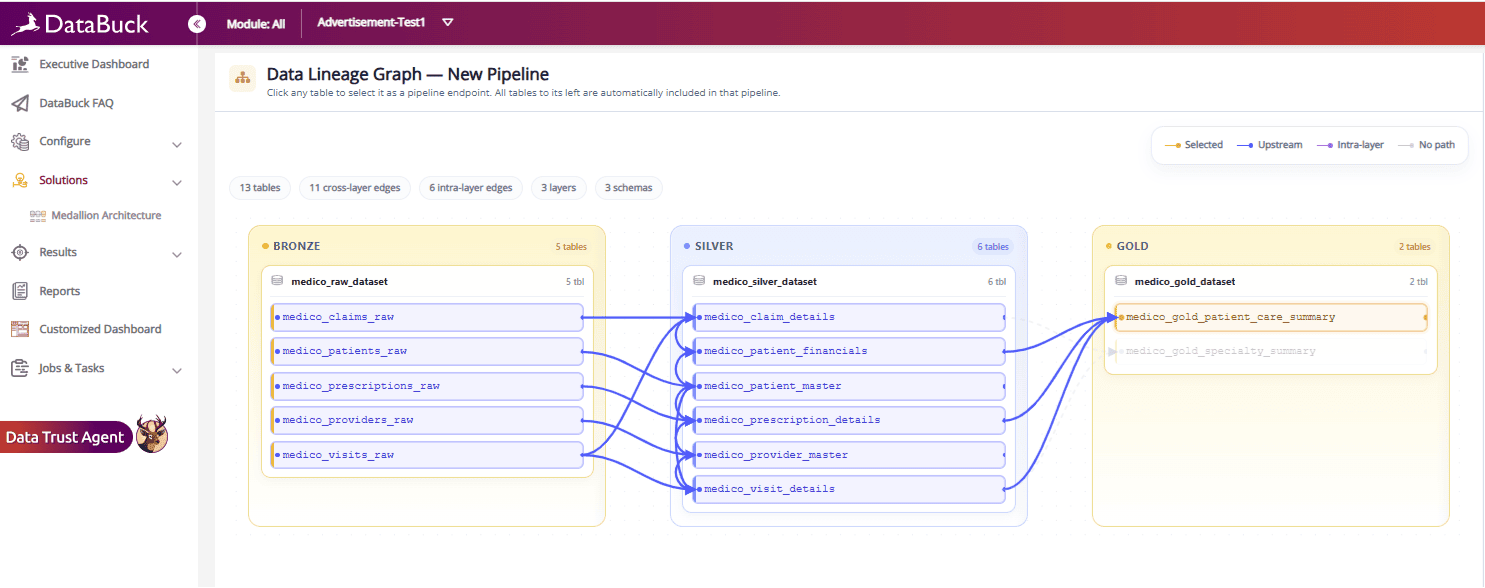
02 / Validate every transition
Trust every layer of your Medallion architecture.
A successful job says the pipeline ran. Validation and reconciliation help show whether the resulting data still means what it should.
Move from isolated checks at each table to evidence across the transitions between Bronze, Silver and Gold.
Bronze
Validate raw ingestion, structure and completeness before downstream work begins.
Bronze ↔ Silver
Reconcile transformed records, keys and fields against their source.
Silver ↔ Gold
Verify aggregates, mappings and business logic as data becomes a product.
Gold
Validate consumption readiness before reporting, BI and AI use the data.
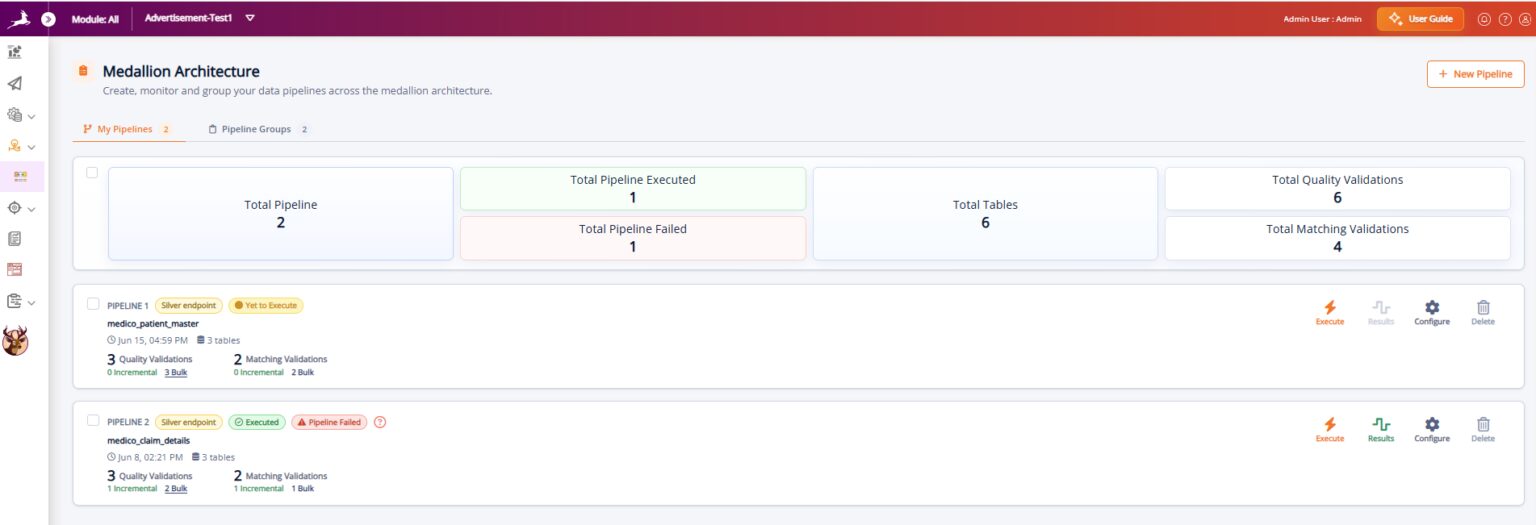
Don't just monitor the pipeline. Validate intended changes.
When data moves between layers—or between platforms—compare source and target so teams can distinguish expected transformations from missing records, changed values and broken business logic.
What to Reconcile
- 01 Source-to-target matching across migrations
- 02 Table-to-table comparisons across pipeline stages
- 03 Aggregate and control-total validation
- 04 Record-level and field-level mismatch investigation
- 05 Cross-platform validation for legacy and cloud systems
For cloud migrations: DataBuck's pushdown matching capability executes reconciliation computation inside Databricks as part of its Data Matching capabilities and integration services. Scope and implementation depend on the environment.
04 / Operationalize policy
Make business
policy testable
A quality rule should reflect the standard it protects. BuckGPT helps translate policies, regulations and business requirements into recommended validations for people to review and approve.
01 / 05
Policy / standard
The requirement to uphold
02 / 05
BuckGPT
Interpret business context
03 / 05
Recommended rule
A reviewable quality check
04 / 05
Human approval
Keep decisions accountable
05 / 05
Validation
Check data against the rule
- DataBuck SDK / Databricks-native validation
DataBuck SDK: Context-Aware
Data Quality for Databricks
Discover once, validate natively.
DataBuck SDK generates Databricks-native expectations, allowing data engineers to use the Databricks validation engine directly within their existing pipelines. This approach simplifies adoption, avoids unnecessary data movement, and enables teams to incorporate intelligent data quality checks into their existing workflows.
Bring quality conversations into the way engineers work: notebooks, Python and Spark development, peer review and pipeline planning. Evaluate recommended rules before choosing where and how to enforce them in your Databricks environment.
WORKFLOW SKETCH
- 01 Discover candidate rules from context
- 02 Review recommendations with data owners
- 03 Choose validation in notebooks or pipelines
- 04 Inspect failures and reconcile the result
- 05 Approve the next action
Why DataBuck over Databricks DQX?
While DQX offers automated profiling and AI-assisted rule generation, DataBuck is designed to go further by combining statistical analysis with enterprise business context to discover more meaningful rules. Its focus on precise rule recommendations, complex data relationships, and cross-platform reconciliation extends beyond conventional lakehouse validation. DataBuck complements Databricks-native validation while providing a path toward enterprise-wide data trust across multiple platforms.
What this makes possible
More than knowing
something changed.
Give engineering teams a way to decide whether data is fit for its next use,
with validation evidence across the path.
01 / OUTCOME
Less rule engineering
Start from context-aware recommendations instead of a blank rule editor.
02 / OUTCOME
Reviewed transformations
Check whether each Medallion change produced the intended result.
03 / OUTCOME
Migration evidence
Investigate source-to-target mismatches before cutover decisions.
04 / OUTCOME
Safer downstream use
Put quality decisions ahead of analytics, BI and AI consumption.
05 / OUTCOME
Operational policy
Translate business and regulatory requirements into reviewable checks.
06 / OUTCOME
Validation near the data
Use pushdown matching for Databricks migration reconciliation.
Downstream AI
Better answers begin
before the prompt.
Genie and Agent Bricks can consume datasets that have been checked upstream. DataBuck validates the underlying data—not Genie responses, agent behavior or generated output.
See the evidence
Inside the quality workflow.
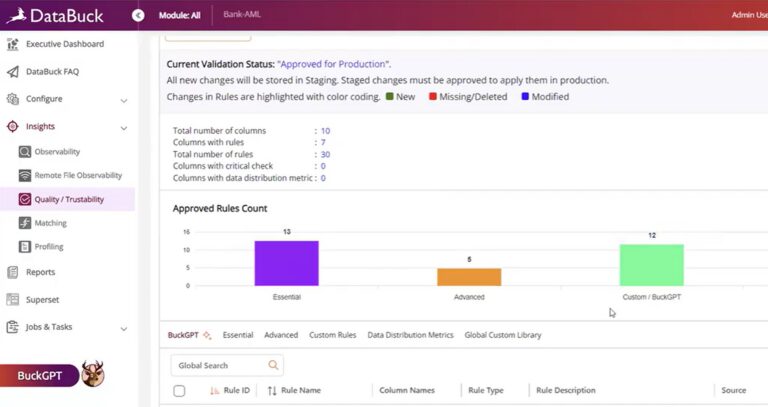
Explore DataBuck's trust scores and validation results, from quality trends to the findings your team uses to investigate data quality.

Data Trust Score
Track quality trends and trust scores across your data assets.

Validation results
Review quality findings on monitored assets.

Published DataBuck customer story
Toyota: confidence in supply-chain data.
Toyota used context-aware data quality to reduce false alerts and reconcile legacy mainframe and modern NoSQL data for supply-chain analytics. This is broader DataBuck customer evidence, not a Databricks-specific deployment.
Trusted by the World’s Leading Enterprises






What Customers Are Saying About Us
Scroll to read more customer stories →


First Eigen has helped us tremendously with our sales attribution. Their data solutions are precise and consistent, and the team is great to work with. The confidence we have in First Eigen's data solutions has allowed us to focus on other areas of our business. We highly recommend First Eigen to any organization looking to elevate their data accuracy and performance.

DataBuck has been instrumental in ensuring data quality on our Hadoop platform. Its automated profiling and validation features make it easy to identify issues quickly and maintain trust in our data, and the user-friendly interface and flexible rule engine greatly accelerates data quality initiatives. I would highly recommend DataBuck for any organization looking to strengthen their data quality processes.

DataBuck by FirstEigen is a powerful, ML-driven data quality tool that not only automated complex validation tasks at scale but also integrated seamlessly with our GCP environment, significantly improving data trust while reducing manual effort by 50%.

DataBuck's automated data quality validation capability was used to validate sales data of the US Commercial operations. Its DQ rules recommendation engine can significantly reduce manual data validation efforts, improve issue detection, and enhance confidence in downstream analytics and reporting. DataBuck's scalability and improved transparency to data trust make it a valuable asset in any complex data environment.
The practical questions
Before
you build.
The important details behind a context-aware quality workflow on Databricks.