
Trusted by the World’s Leading Enterprises
Helping data, governance and AI teams across finance, telecom, healthcare,
and retail protect what matters most.






The Visibility Gap
You Can't Protect Data You Can't Find
Sensitive data spreads across thousands of tables — and most teams can't say where, why or what to do about it.
It Hides Everywhere
PII, PHI and financial data sit in thousands of unlabeled tables and ambiguously named columns — with no clear owner.
Scanners Miss Context
Pattern-based tools catch obvious values like SSNs, but miss sensitive data hiding behind names like customer_reference.
Labels Without Answers
Even when data is flagged, teams can't tell why it's sensitive or what to do next — so nothing gets protected.
That's where DataBuck comes in — turning scattered, unlabeled data into a
clear, prioritized picture of risk.
Sensitive Data Dashboard
Find What Needs Attention First
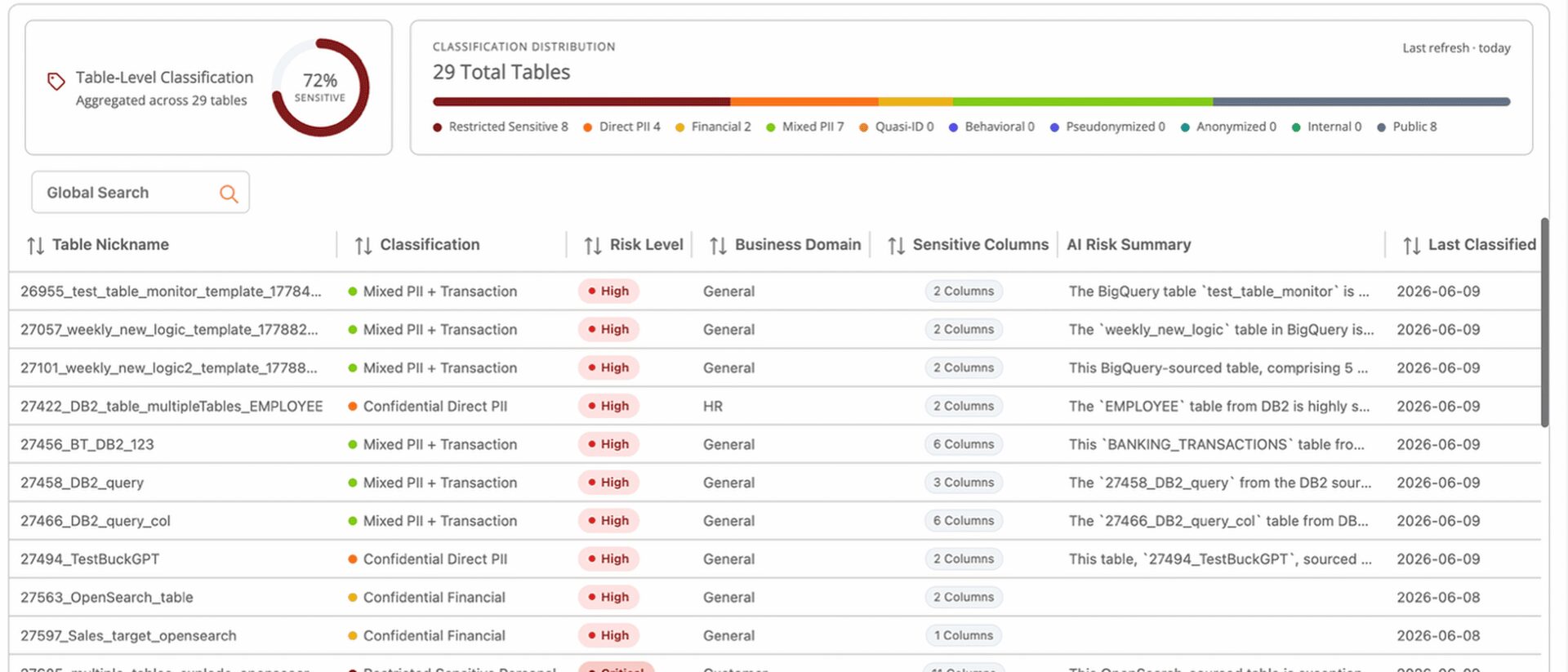
The Sensitive Data Dashboard gives teams a consolidated view of where
sensitive information has been detected — so investigation starts with the
assets presenting the greatest potential risk, not every dataset manually.
1
Marker 11.Tables Containing Sensitive Data
A consolidated inventory of every table where sensitive information has been detected.
2
Marker 22.Sensitivity & Risk Levels
Overall sensitivity and risk levels assessed per dataset to guide prioritization.
3
Marker 33.Detected Data Types
The types of sensitive data detected — personally identifiable information (PII), protected health information (PHI), financial data and more.
4
Marker 44.AI-Generated Summaries
Plain-language dataset summaries describing what was found and why it matters.
5
Marker 55.Recommended Security Actions
Practical next steps such as masking, labeling or restricting access.
6
Marker 66.Search & Filtering
Quickly focus on high-risk tables, specific sensitive data types or datasets requiring immediate review.
Hover or click a numbered marker on the dashboard to see where each capability lives in the product.
Benefits
Turn Sensitive Data Discovery Into Action
Automatically Detect Sensitive Data
Continuously analyze connected enterprise datasets to identify columns containing personal, healthcare, financial and other confidential information.
Prioritize the Highest-Risk Datasets
Use AI-generated risk classifications to separate lower-risk data from datasets requiring immediate governance or security review.
Understand Every Classification
See a clear explanation of why a table or column was classified as sensitive rather than relying on an unexplained label.
Strengthen Compliance Readiness
Create a more consistent and reviewable inventory of sensitive data to support internal governance, privacy and compliance programs.
Reduce Manual Classification Work by 90%
Replace spreadsheet-based inventories with automated data classification tools powered by AI.
Find What Matters Faster
Search and filter classified tables by sensitivity type, risk level and other relevant attributes.
Column-Level Classification
AI-Powered Column-Level Data Classification
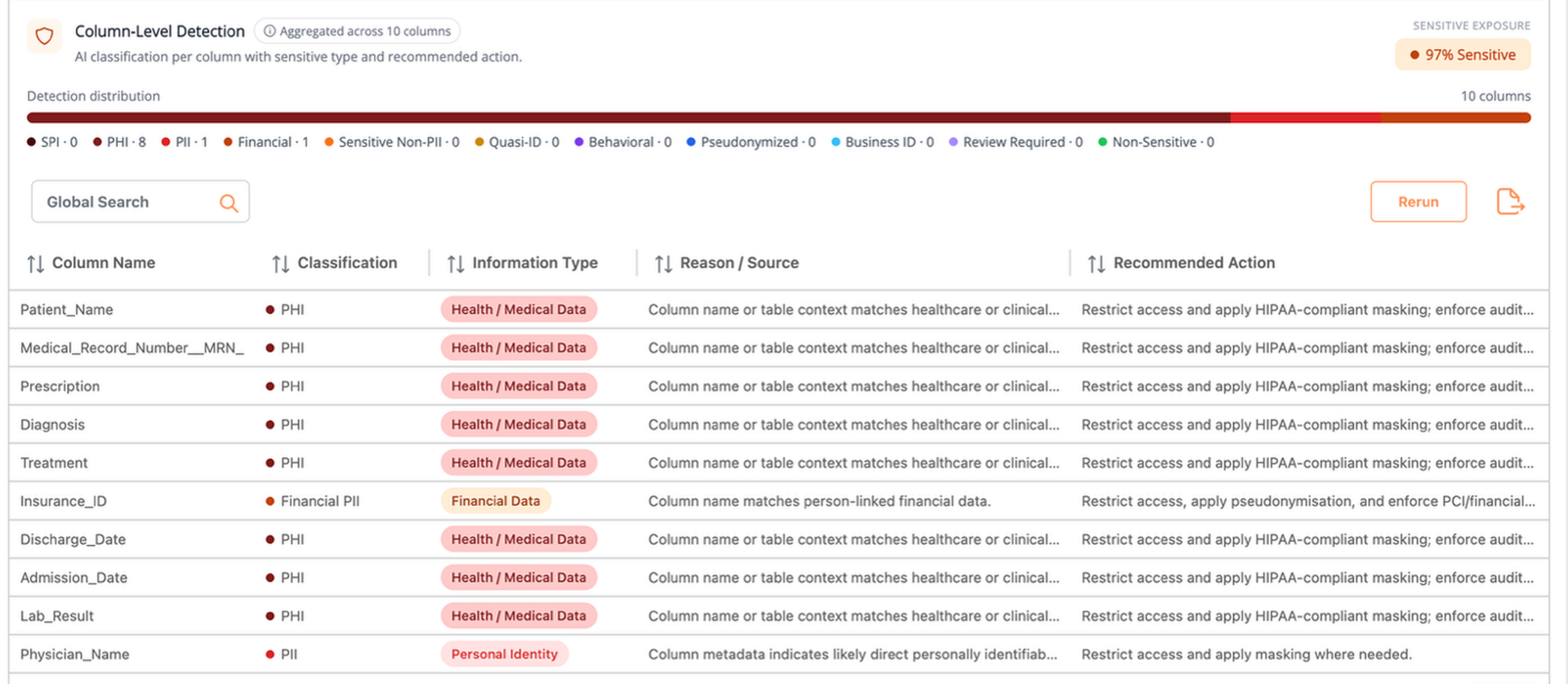
Sensitive information often exists inside columns whose names do not clearly describe their contents. A column called customer_reference, member_value or account_attribute may contain sensitive information even though its name does not include obvious terms such as “SSN,” “patient” or “credit card.”
DataBuck analyzes column names, metadata, values and surrounding dataset context to determine whether a column may contain sensitive information. Each classification includes an AI-generated explanation so users can understand the reasoning and review the result with confidence.
Accurate column-level classification
AI-generated explanations
Actionable security recommendations
Improved compliance readiness
Reduced manual effort
Explainable AI
Move Beyond Labels With Explainable AI
A classification is only useful when teams understand what it means and how they should respond. For every sensitive column, DataBuck can provide the identified category, the reason behind the classification, the assessed level of risk, the business context influencing the result, and a recommended governance or security action.
Recommendations help data governance and compliance teams move from discovery to a clear next step without manually interpreting every result.
Protect Sensitive Data
Before It Creates Risk
“FirstEigen is a powerful, ML-driven data quality tool that not only automated complex validation tasks at scale but also integrated seamlessly with our GCP environment, significantly improving data trust while reducing manual effort by 50%.”

“FirstEigen automated data quality validation capability was used to validate sales data of the US Commercial operations. Its DQ rules recommendation engine can significantly reduce manual data validation efforts, improve issue detection, and enhance confidence in downstream analytics and reporting.”

"FirstEigen has been instrumental in ensuring data quality on our Hadoop platform. Its automated profiling and validation features make it easy to identify issues quickly and maintain trust in our data. I would highly recommend DataBuck for any organization looking to strengthen their data quality processes."

“FirstEigen has helped us tremendously with our sales attribution. Their data solutions are precise and consistent, and the team is great to work with. We highly recommend First Eigen to any organization looking to elevate their data accuracy and performance.”

How It Works
How AI-Powered Sensitive Data Discovery Software Works
Connect
Select the data assets, schemas or environments to evaluate.
Analyze
Column names, metadata, patterns and business context are evaluated.
Identify
Columns are classified as PII, PHI, financial or other sensitive data.
Assess Risk
Each table receives a risk level from its combined classifications.
Explain
AI summaries show what was found and why it matters.
Act
Get recommendations like masking, labeling or access controls.
Integrations
Works Where Your Data Lives
Discover and classify sensitive data across your cloud warehouses, lakes,
databases, and pipelines — no data ever leaves your environment.

Redshift

Snowflake

Atlan

Alation

Purview

Teradata

PostgreSQL

BigQuery

DBT

Airflow

Databricks

Oracle
AI Readiness
Prevent Sensitive Data From Reaching AI Unchecked
AI applications, agents and retrieval pipelines can access data at a scale that is difficult to review manually. Without reliable classification, sensitive customer, employee, patient or financial information may be included in AI workflows unnoticed.
DataBuck helps organizations identify sensitive columns before enterprise data is approved for AI use. Data and AI leaders gain a clearer view of which datasets are safe to use, which require additional controls and which should be restricted from an AI workflow.
Industry Use Cases
Built for Data-Intensive and Regulated Industries
Sensitive data risk looks different in every regulated industry. The AI-Powered
Sensitive Data Detection solution automatically identifies and classifies
sensitive information across enterprise datasets.

Locate Regulated Customer Data Across Sprawling Systems
Find customer PII, payment and PCI data wherever it lives — before regulators or attackers do.
- Discover PCI and GLBA-relevant data across all systems
- Flag identifiers hiding in ambiguously named columns
- Prioritize masking on the highest-risk tables

Classify Policyholder and Claims Data Across Core Systems
Policy and claims records mix PII, PHI and financial data — DataBuck gives each column the right protection.
- Classify mixed policy, claims and medical data by column
- See why each field was flagged with explainable AI
- Apply the right control — masking, labels or access

Discover PHI at Scale to Support HIPAA Compliance
PHI and patient data spread far beyond the EHR — DataBuck detects it and recommends protective action.
- Detect patient identifiers and clinical data outside the EHR
- Surface HIPAA-relevant columns with risk explanations
- Reduce exposure before analytics, AI or non-production use
Why DataBuck
Sensitive Data Classification With Business Context
Traditional detection methods often depend heavily on column names, keywords, and
fixed patterns. DataBuck brings data classification into a broader data-trust workflow —
combining automated analysis with business context to help teams understand not only
whether data appears sensitive, but also why the classification matters.
| What You Can Do | How DataBuck Delivers |
|---|---|
| Discover Sensitive Data | Automatically discover sensitive data across databases, warehouses and data lakes — without manual inventories. |
| Column-Level Sensitivity Analysis | Analyze sensitivity at the individual-column level, including ambiguously named fields. |
| Explainable AI Classifications | Understand the reasoning behind every classification instead of relying on opaque labels. |
| Table-Level Risk Assessment | Assess risk across complete tables based on the combined classifications within them. |
| Search & Filter Findings | Search and filter sensitive data findings by type, risk level and classification status. |
| Actionable Recommendations | Receive actionable protection recommendations such as masking, labeling or access restriction. |
| Reduced Manual Review | Reduce repetitive manual review with automated, AI-assisted classification. |
| AI-Ready Data Preparation | Prepare trusted and appropriately controlled data for AI models, agents and pipelines. |
FAQ
Frequently Asked Questions
Everything you need to know about AI-powered sensitive data discovery and classification.