

Angsuman Dutta
CTO, FirstEigen
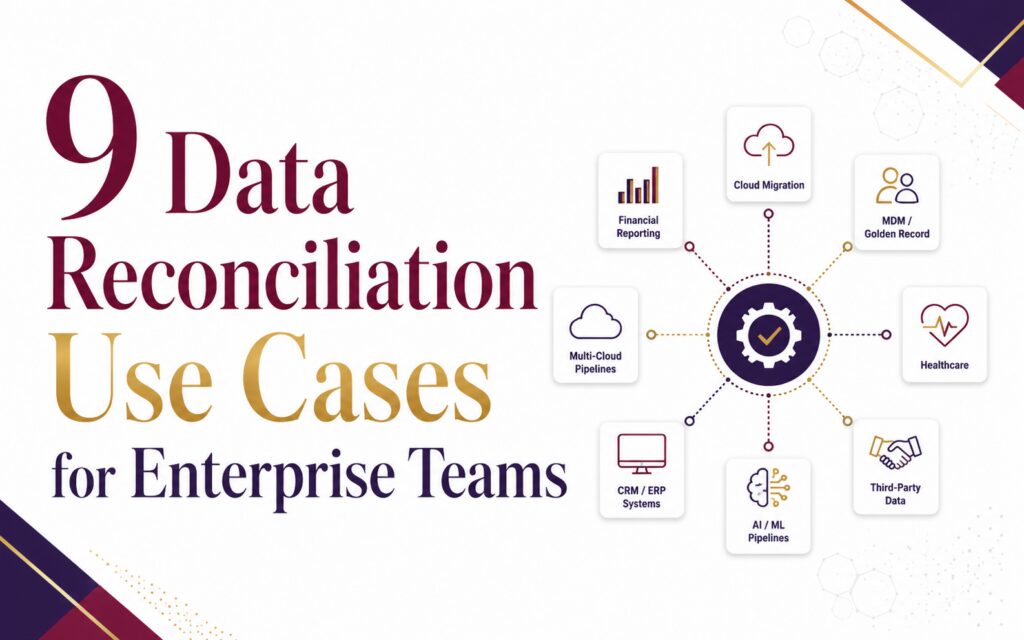
9 Ways Enterprise Teams Use Data Reconciliation
Data reconciliation is often mistaken for an accounting-only process.
For data teams, the concept is much broader.
Whenever an important business fact is copied, transformed, migrated, aggregated, merged, or received from another system, the organization needs some way to determine whether the resulting data still agrees with what it should represent.
IBM’s definition of data reconciliation focuses on comparing and verifying information across systems to support accuracy, integrity, and consistency.
The practical question is: Can we account for the data as it moves from one system or representation to another?
That question appears in cloud migrations, M&A, financial reporting, CRM and ERP integration, hybrid data architectures, MDM, third-party feeds, healthcare, and AI.
Here are nine enterprise data reconciliation use cases where reconciliation can provide meaningful control. If you already know you need technology to automate these processes, continue with our guide to evaluating data reconciliation software.
What Counts as an Enterprise Data Reconciliation Use Case?
A useful enterprise data reconciliation use case has two two characteristics.
First, there is a relationship between two or more representations of the same business information.
Second, a discrepancy between those representations could matter.
A reconciliation may therefore compare:
- source vs. target;
- system A vs. system B;
- pipeline input vs. output;
- raw vs. transformed data;
- internal vs. third-party data;
- master vs. source record;
- reported metric vs. underlying dataset.
The comparison does not always require literal equality. Sometimes the correct relationship is Source = Target. But it may also be Source = Target + Known Exclusions, or SUM(Source Transactions) = Target Aggregate.
The business rule determines whether the data reconciles.
Enterprise Data Reconciliation Use Cases
1. Data Reconciliation for Cloud Migration
Cloud migration is one of the clearest reconciliation use cases.
An enterprise may move data from Oracle to Snowflake, Teradata to BigQuery, a mainframe to Databricks, SQL Server to a cloud database, or Hadoop to a lakehouse.
A migration tool can successfully transfer data without proving that every important business value survived correctly.
This is where data pipeline validation becomes important, helping teams verify data as it moves between source and target environments. Data reconciliation for data migration helps verify that important business values survive the move correctly.
Google’s data validation guidance for migrations recommends comparing source and destination data using data reconciliation techniques such as schema mappings, row counts, sample records, aggregates, and row-level validation.
What can go wrong?
- Records disappear.
- Rows duplicate.
- Numeric precision changes.
- Data types change.
- Mapping logic is wrong.
- Transformations alter values.
- Late-arriving records are excluded.
Example
Legacy source: 12,400,000 transactions
Cloud target: 12,399,982 transactions
The infrastructure migration succeeded, but 18 transactions are unaccounted for.
A migration reconciliation process should help identify which records are missing, where they disappeared, whether the difference is expected, and whether downstream users can safely cut over.
FirstEigen’s mainframe-to-cloud reconciliation guide describes this problem across legacy mainframe systems and modern analytics platforms and recommends validation across migration stages rather than only at the end.
What to automate first
Start with schema, counts, critical keys, high-value aggregates, and record-level comparisons for critical tables. Then expand coverage based on risk.
2. Data Reconciliation for Mergers & Acquisitions
M&A creates a data problem immediately.
Data reconciliation for M&A helps identify differences across customers, suppliers, products, contracts, transactions, and financial balances.
Company A and Company B may both have customers, suppliers, products, contracts, transactions, employees, and financial balances. But they rarely use identical identifiers or business definitions.
Consider:
Company A customer: C-40992
Company B customer: ACCT-7741
Both might represent the same organization.
Data matching can establish the identity relationship. Reconciliation then asks whether associated facts agree.
Company A might report annual contract value of $2.4 million, while Company B reports $2.1 million.
Why?
- Different currency treatment?
- Different contract dates?
- Duplicate opportunity?
- One stale system?
- Different definition of annual contract value?
Reconciliation exposes the question before consolidated reporting treats one representation as truth.
M&A reconciliation priorities
- customer overlap;
- supplier overlap;
- product masters;
- account balances;
- contracts;
- inventory;
- revenue;
- open orders;
- reporting metrics.
Reconciliation becomes particularly important when management needs consolidated reporting before every legacy platform has been retired.
3. Data Reconciliation for Financial Reporting
Financial data frequently passes through several systems before reaching external or management reporting.
For example:
transaction systems -> ERP -> data warehouse -> consolidation -> financial report.
A difference anywhere in that chain can affect the reported outcome.
Automated reconciliation can compare transactions vs. ledger, subledger vs. general ledger, operational totals vs. warehouse totals, or warehouse vs. reporting layer.
These controls contribute to broader data trust by giving teams evidence that reported values agree with their underlying sources.
Regulatory context needs precision
For U.S. public companies, PCAOB AS 2201 concerns internal control over financial reporting and emphasizes controls that provide reasonable assurance around reliable financial reporting. It does not require companies to purchase “data reconciliation software.”
For banks subject to relevant supervisory expectations, BCBS 239 focuses on effective risk-data aggregation and reporting. It does not prescribe a named reconciliation product.
Reconciliation can support these broader control objectives when it is part of the organization’s designed process.
What to automate first
Prioritize high-materiality financial datasets, recurring regulatory datasets, critical management reports, and manual spreadsheet reconciliations consuming substantial staff time.
One of the key data reconciliation best practices is to prioritize high-materiality financial datasets, recurring regulatory datasets, critical management reports, and manual spreadsheet reconciliations consuming substantial staff time.
4. CRM-to-ERP Revenue Reconciliation
Sales and finance often see the same commercial process through different systems.
A CRM may contain opportunities, bookings, contract values, and close dates. An ERP may contain orders, invoices, recognized revenue, and receivables.
Problems appear when leadership expects numbers from both systems to align automatically.
Example
CRM closed-won bookings: $42.5M
ERP booked orders: $41.8M
The difference may be legitimate.
Perhaps some deals await order creation, one booking was cancelled, different exchange rates were used, renewals are treated differently, or the reporting windows differ.
The purpose of reconciliation is not to force both numbers to be identical. It is to make the $700K variance explainable.
What to reconcile
- customer/account mapping;
- opportunity/order mapping;
- product mapping;
- booking amount;
- order value;
- invoice amount;
- currency;
- dates;
- status.
The result gives RevOps, Finance, and Data teams a shared way to investigate variances instead of comparing exported spreadsheets every reporting cycle.
5. Data Reconciliation for Multi-Cloud Pipeline
Many enterprises do not operate one data platform.
A realistic environment might contain on-premises Oracle, AWS S3, Snowflake, Azure Data Lake, Databricks, BigQuery, and SaaS applications.
Information may move between several of them. Every transfer becomes a possible reconciliation boundary. Reconciliation automation can help teams monitor these boundaries repeatedly instead of relying on one-off comparisons.
Example
Operational data starts in Oracle. It is exported to object storage. A processing job transforms it in Databricks. Curated results move to Snowflake. BI reads Snowflake.
A dashboard is wrong. Where did the error begin?
If reconciliation exists only between Oracle and the dashboard, the organization knows something changed but not where. Controls at intermediate boundaries can narrow the problem.
A possible reconciliation chain is:
- Oracle -> landing;
- landing -> processing;
- processing -> warehouse;
- warehouse -> consumption.
FirstEigen’s Data Observability platform can complement this approach by monitoring characteristics such as freshness, volume, schema, and pipeline behavior, while reconciliation directly tests agreement between corresponding datasets.
Why both matter
Observability can indicate unusual behavior. Reconciliation can establish whether two related datasets actually agree. Those are related but distinct questions.
6. Master Data Management and Golden Record Validation
Master Data Management attempts to create consistent representations of important business entities such as customers, suppliers, products, locations, and employees.
Multiple source records may be resolved into a master or golden record.
But creating the golden record introduces another control question: Does the resulting master correctly represent the approved source information?
Example
CRM: Acme Corporation
ERP: ACME Corp
Billing: Acme Corp.
Matching concludes these belong to the same entity. The MDM system creates Acme Corporation.
That may be correct.
But consider the address:
CRM: Chicago
ERP: Chicago
Billing: New York
Which value survives? A survivorship rule decides.
Reconciliation can help verify that the published golden record follows the intended source hierarchy and business rules.
What to reconcile
- source membership;
- surviving values;
- reference identifiers;
- master-to-source relationships;
- approved overrides;
- downstream distribution.
For cross-system matching and MDM-style consistency, see FirstEigen’s data matching software capabilities.
7. Third-Party Data Feed Reconciliation
Enterprises increasingly depend on information they do not create themselves. This is a common automated reconciliation use case when vendor feeds arrive frequently or at high volume.
Examples include credit bureaus, market-data feeds, healthcare eligibility files, logistics partners, payment processors, demographic providers, supplier files, and advertising platforms.
A file arriving successfully does not prove its contents are complete or correct.
Example
A vendor normally delivers 5 million records daily. Today’s file also contains 5 million records, so a simple volume check passes.
But 300,000 expected entities have disappeared and 300,000 old entities have been repeated.
Total volume looks normal. Reconciliation against expected identifiers, prior versions, authoritative internal records, or relevant totals can expose the difference.
Controls can include
- expected entities;
- duplicate amplification;
- balances;
- aggregates;
- effective dates;
- coverage by segment;
- schema consistency;
- known reference values.
The exact controls depend on the business relationship with the provider.
8. Data Reconciliation in Healthcare
Healthcare highlights why identity and consistency need to work together.
Patient information can exist across EHR, billing, laboratory systems, scheduling, insurance, pharmacy, and external providers.
The first challenge is matching the patient correctly. GAO research on patient matching found that providers use demographic information such as names and dates of birth to match records and that incomplete, inaccurate, or inconsistently formatted information can create matching challenges. Some potential matches may require manual review.
Once identity is established, reconciliation can compare corresponding information across systems.
Example
Clinical system: Patient insurance status = active.
Eligibility feed: Status = inactive.
Billing: Claim submitted as active.
Which representation is current?
The data team needs to identify the discrepancy before assuming one system is correct.
Relevant reconciliation scenarios
- patient demographics;
- eligibility;
- provider records;
- claims;
- billing;
- enrollment;
- scheduling.
The appropriate controls will depend on the organization’s systems and regulatory obligations.
9. AI/ML Training Data and Agentic Pipeline Reconciliation
AI creates a newer reconciliation boundary. Data reconciliation for AI pipelines helps verify that data remains consistent as it moves through extraction, transformation, indexing, feature generation, and AI workflows.
Models and AI systems increasingly depend on enterprise data that has been extracted, filtered, transformed, aggregated, chunked, indexed, converted into features, or delivered through APIs and tools.
These workflows make data quality for AI initiatives closely connected to reconciliation, since each transformation can introduce differences from the authoritative source.
Every stage creates the possibility that the data consumed by the AI system differs materially from its authoritative source.
Training-data example
An eligibility process identifies 10 million approved training records. The feature pipeline produces 9.2 million.
Why are 800,000 missing?
An intentional filter may explain them. Or a broken transformation may have removed them. The model training job itself may complete successfully either way.
RAG example
A knowledge pipeline contains 50,000 approved source documents. Only 46,000 reach the downstream indexed corpus.
That difference should be explainable before the organization assumes the knowledge base is complete.
AI agent example
The stakes can increase further when an AI agent uses operational information to make or recommend actions.
Suppose an agent receives:
Inventory available: 1,200 units
while the authoritative operational source shows:
120 units
The agent may reason correctly from the input and still reach an inappropriate business decision.
Reconciliation does not guarantee correct AI behavior. It addresses one narrower but important question: Did the data supplied to the AI workflow remain consistent with the authoritative business source according to the controls we defined?
FirstEigen’s broader DataBuck platform is positioned around validating data across sources, pipelines, data-lake/lakehouse layers, and downstream consumption. Reconciliation can therefore be considered one control within a wider data-trust architecture rather than a substitute for model evaluation or AI governance.
How to Prioritize Which Use Case to Automate First
Do not automate based solely on which reconciliation is easiest.
Prioritize using four factors:
1. Business impact
What happens if the data is wrong?
2. Frequency
Does the process run once a year or every hour?
3. Probability of discrepancy
How often do differences occur or change?
4. Control importance
Does the data support financial reporting, regulatory processes, customer operations, executive decisions, or high-impact automation?
A simple framework is:
Priority = Impact x Frequency x Error Likelihood x Control Importance
Consider two examples.
Internal cafeteria-menu feed: low business impact, daily frequency, moderate error probability, low control importance.
Financial transaction pipeline feeding executive reporting: high impact, daily frequency, nonzero error probability, high control importance.
The second clearly deserves stronger automated reconciliation.
When Manual Reconciliation Stops Working
Manual reconciliation can be perfectly reasonable for a small, infrequent workflow.
Two CSV files. A spreadsheet. A lookup. A few variances.
The model breaks down when the environment becomes large, frequent, complex, or business-critical.
Consider:
500 tables x 8 reconciliation checks x daily execution = 4,000 checks every day.
At that point, teams need an automated reconciliation process for execution, evidence, exception routing, and investigation.
Google’s Data Validation Tool is one example of making cross-environment source-target validation repeatable and automated instead of relying entirely on one-off comparison scripts.
Summary: What to Reconcile in Each Use Case
| Use case | Typical comparison | Key checks | Primary risk |
| Cloud migration | Legacy source vs. cloud target | Schema, counts, records, values, aggregates | Lost or changed data |
| M&A | Company A vs. Company B | Entity mapping, balances, contracts, metrics | Inconsistent consolidation |
| Financial/reporting | Transaction/ledger/report layers | IDs, balances, totals, evidence | Misstatement or unsupported reporting |
| CRM to ERP | Bookings vs. orders/invoices | Account, amount, status, dates | Forecast/revenue variance |
| Multi-cloud | Platform stage vs. next stage | Counts, values, transformations | Silent pipeline drift |
| MDM | Golden record vs. source systems | Survivorship, IDs, mappings | Incorrect master data |
| Third-party feeds | Vendor feed vs. expected/internal state | Coverage, duplicates, totals, dates | Incomplete or stale external data |
| Healthcare | Clinical/billing/eligibility systems | Identity, eligibility, claims, demographics | Operational inconsistency |
| AI/ML | Authoritative source vs. AI-ready representation | Completeness, values, versions, transformations | Unreliable AI inputs |
The Bottom Line
Data reconciliation should not be treated as one narrow finance workflow.
The same underlying control appears whenever enterprise data moves between representations: cloud migration, M&A, financial reporting, CRM and ERP, multi-cloud pipelines, MDM, third-party feeds, healthcare, and AI.
The question is always some variation of:
- Can we demonstrate that the expected data arrived?
- Can we explain what changed?
- Can we account for intentional transformations?
- Can we identify material mismatches quickly?
Where that question matters frequently and at scale, automated reconciliation becomes much more valuable than another collection of manual SQL queries and spreadsheets.
Enterprise-grade data reconciliation tools can help automate these recurring comparisons at scale.
See how automated reconciliation can improve data accuracy across your systems. Contact Us or Book a Demo today.
FAQs
Data reconciliation is the process of comparing related data across systems, pipelines, or representations to determine whether they agree according to defined business rules. It helps identify missing, duplicated, changed, or inconsistent data before it affects downstream processes.

Discover How Fortune 500 Companies Use DataBuck to Cut Data Validation Costs by 50%

Enter your email address to access to downloads
Recent Posts
Why Data Quality Teams Need More Than Automated Rules
Great Expectations Killed Automated Rule Discovery. Here’s Why the Industry Got Rules Discovery Wrong. Auto-generating 100 rules in 60 seconds helped data…
9 Ways Enterprise Teams Use Data Reconciliation
Data reconciliation is often mistaken for an accounting-only process. For data teams, the concept is much broader. Whenever an important…
How to Evaluate Data Reconciliation Software in 2026
Search for “data reconciliation software,” and you can quickly encounter two very different categories of products. One is designed primarily for finance teams reconciling…
Bad Data Is Costing You More Than You Think