

Rehan Mujawar
AI Solution Architect
Why Data Trust Is the Real Foundation of AI Success
Enterprises are racing to adopt AI—LLMs, copilots, and autonomous agents that can trigger actions across systems. But as AI moves from “insight” to “execution,” one truth becomes unavoidable:
AI is only as good as the data it learns from and acts on.
Why Trusted Data for AI Matters
Data Trust for AI starts with ensuring that enterprise data is accurate, validated, and reliable before it reaches AI systems.
Modern models are powerful, but they cannot compensate for inconsistent, incomplete, or unreliable data. And the risk is no longer limited to a bad dashboard or a wrong report. With AI-driven automation, poor data trust gaps multiply the blast radius—because errors happen faster, propagate across workflows, and often occur without a human in the loop.
Gartner found that by the end of 2025, at least 50% of generative AI projects were abandoned after the proof-of-concept stage due to poor data quality, inadequate risk controls, escalating costs, or unclear business value.
The Missing AI Trust Layer in Enterprise AI
Before any AI system analyzes, predicts, or triggers business processes, the underlying data must be validated, reconciled, and trusted. That’s where DataBuck becomes a critical part of the AI ecosystem: it acts as a data quality + trust gatekeeper across your pipelines.
How DataBuck Supports Data Quality for AI
DataBuck enforces:
- Consistency (data matches rules and expectations)
- Completeness (required fields and records are present)
- Correctness (values are valid, accurate, and reconcilable)
DataBuck is the AI trust layer that supports AI by validating and reconciling enterprise data before it reaches models, copilots, or agents—so AI operates on accurate, reliable inputs. Without this layer, AI systems can produce outputs that are confident—but wrong—leading to flawed decisions, revenue leakage, operational incidents, and compliance exposure.
How Data Trust Improves AI Outcomes
Data trust doesn’t improve AI linearly—it improves it exponentially. Organizations that measure data reliability through a data trust score are better positioned to improve AI accuracy, automation, and business outcomes.
The relationship between data trust and AI performance is rarely a straight line. Organizations that improve AI data quality often see more consistent and reliable model outcomes. When data trust is low, models struggle to learn stable patterns—features degrade, predictions swing, and outcomes become unreliable. As data integrity and trust improve, the model’s ability to generalize rises sharply, producing more consistent and repeatable results.
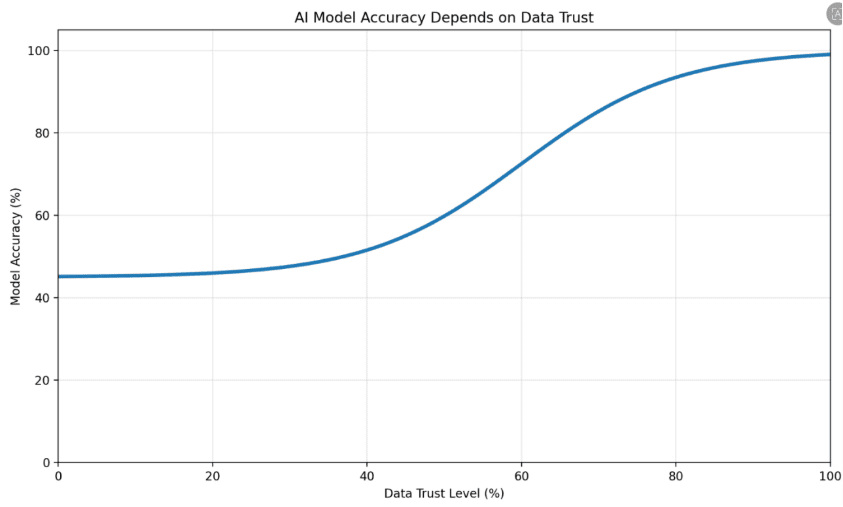
The Relationship Between AI Data Quality and Accuracy
That’s the universal machine learning lesson (as the graph shows):
higher data trust → stronger signals → better features → higher accuracy → safer automation
Why Data for AI Agents Must Be Trusted
In an AI-first world, DataBuck becomes more essential—not less
Many platforms focus on automation and orchestration. But as AI adoption grows, the need for trusted data solutions, governance, reconciliation, and continuous validation becomes non-negotiable. AI accelerates outcomes only when it runs on data that is accurate and dependable—and that’s exactly what DataBuck ensures before AI begins.
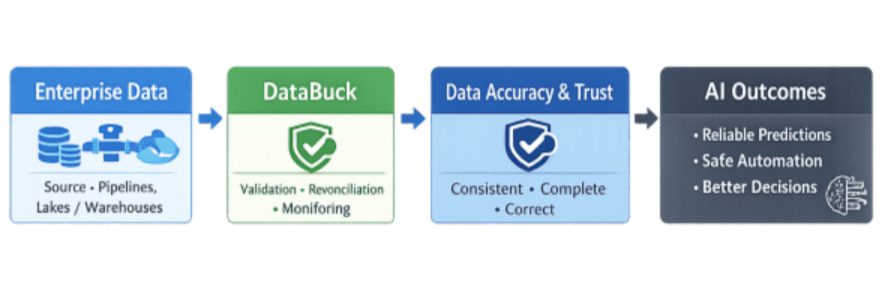
Bottom line: If AI is the engine, trusted data for AI is the fuel — and DataBuck , our data quality software is the layer that ensures it’s clean, consistent, and safe to use at scale.

Discover How Fortune 500 Companies Use DataBuck to Cut Data Validation Costs by 50%

Enter your email address to access to downloads
Recent Posts
9 Ways Enterprise Teams Use Data Reconciliation
Data reconciliation is often mistaken for an accounting-only process. For data teams, the concept is much broader. Whenever an important…
How to Evaluate Data Reconciliation Software in 2026
Search for “data reconciliation software,” and you can quickly encounter two very different categories of products. One is designed primarily for finance teams reconciling…
7 Criteria for Data Matching Tools in 2026
A data matching tool evaluation can easily become a feature-counting exercise. Vendor A supports more connectors. Vendor B says it…
Bad Data Is Costing You More Than You Think