

Angsuman Dutta
CTO, FirstEigen
AWS Billing Glitch: A $1.5 Trillion Lesson in Data Reconciliation
A billing glitch turned Cost Explorer into a horror movie for a weekend. Nobody paid a cent, but the failure underneath is one for every data team, and every AI agent, should recognize.
What Happened During the AWS Billing Glitch
On the night of July 16, AWS customers watched their Cost Explorer dashboards do something no finance team ever wants to see. A bug inside AWS’s estimated billing computation subsystem started reporting usage growth in the hundreds of billions of percent. Screenshots hit Reddit and Hacker News within hours.

AWS confirmed that the inflated estimates did not reflect customers’ actual usage or charges. However, inaccurate estimated cost data appeared in the Billing and Cost Management Console and, for some configurations, in Cost and Usage Reports. AWS later backfilled corrected data.
No one paid trillion dollars. But the incident is worth sitting with, because it’s a near-perfect illustration of a failure mode that has nothing to do with cloud billing, and everything to do with how modern data systems break.
The underlying usage and actual charges remained accurate, but the estimated billing layer produced incorrect downstream data. The incident shows why computed outputs should be continuously validated against trusted source data before they drive alerts, reports, or automated decisions through continuous data reconciliation and AI data validation, helping organizations avoid the cost of bad data.
According to Gartner, poor data quality costs organizations an average of $12.9 million every year, making continuous data validation and reconciliation a business necessity rather than an operational task.

Why the AWS Billing Issue Matters Beyond Cloud Billing
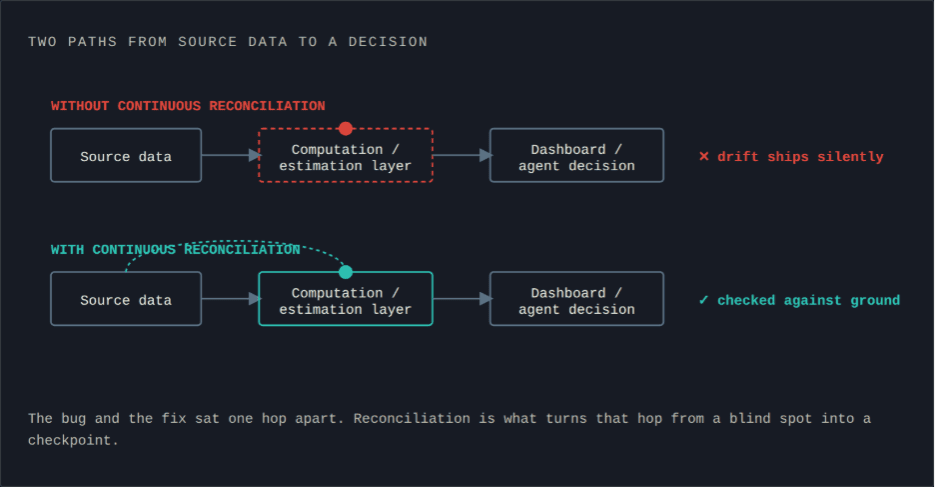
Now replace “AWS billing estimate” with “quarterly revenue rollup,” “regulatory report,” or “the number an AI agent uses to approve a transaction.” The same failure mode plays out inside enterprises constantly, just usually with far less visibility than a viral thread, and far more at stake. A silently mismatched join. A pipeline that quietly drops rows. An aggregation layer that drifts from source systems over weeks instead of hours. Most of it never earns a headline. It just gets discovered in an audit, or in a decision already made on top of bad numbers.
Why Continuous Data Reconciliation Matters
This is the gap that continuous data reconciliation and AI data validation exist to close, comparing what a downstream system reports against what the source of truth actually says, so drift gets caught in minutes, not in a support ticket that goes viral. It’s the same discipline that becomes non-negotiable as organizations hand out more decisions to autonomous AI agents: an agent acting on unvalidated or untrusted data doesn’t just produce a wrong dashboard number; it takes a wrong action.
Why AI Data Validation and Trusted AI Data Matter
AI Data trust isn’t a layer bolted onto infrastructure; it’s the control plane that ensures automated systems, human-facing or agent-facing components, operate honestly.
AWS will recover from this one with an apology and a status-page update. Not every organization’s version of this story ends gently. The lesson isn’t “don’t trust the cloud”, it’s that any system computing a number on your behalf needs an independent, continuous check against ground truth. That’s the unglamorous work of data governance. It is also why a trillion-dollar calculation error became a headline rather than an actual trillion-dollar charge.

How DataBuck Enables Automated Data Reconciliation
This is the exact problem DataBuck, FirstEigen’s AI-powered data validation and data reconciliation platform, is built to close. Instead of a one-time rule check, DataBuck helps organizations perform continuous data reconciliation, AI data validation, and data quality monitoring across enterprise pipelines. It profiles datasets, automatically recommends context-aware checks, monitors changes over time, and flags unexpected drift before unreliable data reaches downstream reports, applications, or AI workflows. As an AI data validation tool, DataBuck establishes expected patterns and thresholds for each dataset through its AI- and no-code ML-driven validation capabilities.
It’s already doing this at enterprise scale: a Fortune 500 bank used DataBuck to cut regulatory compliance risk on its KYC data, Toyota eliminated false alerts while validating 100 million supply-chain records, and Verizon replaced manual rules with autonomous monitoring across 20,000+ BigQuery tables, cutting daily business errors by 93%.
See how enterprise teams put continuous data reconciliation to work
From bank KYC data to Toyota’s supply chain to Verizon’s BigQuery ecosystem, explore how DataBuck catches drift before it becomes a headline.
firsteigen.com/case-studies →
FAQs
AWS attributed the incident to an issue involving unit pricing within its estimated billing computation subsystem. This caused some estimated cost calculations to display dramatically inflated amounts.

Discover How Fortune 500 Companies Use DataBuck to Cut Data Validation Costs by 50%

Enter your email address to access to downloads
Recent Posts
9 Ways Enterprise Teams Use Data Reconciliation
Data reconciliation is often mistaken for an accounting-only process. For data teams, the concept is much broader. Whenever an important…
How to Evaluate Data Reconciliation Software in 2026
Search for “data reconciliation software,” and you can quickly encounter two very different categories of products. One is designed primarily for finance teams reconciling…
7 Criteria for Data Matching Tools in 2026
A data matching tool evaluation can easily become a feature-counting exercise. Vendor A supports more connectors. Vendor B says it…
Bad Data Is Costing You More Than You Think