

Angsuman Dutta
CTO, FirstEigen
7 Criteria for Data Matching Tools in 2026
A data matching tool evaluation can easily become a feature-counting exercise.
Vendor A supports more connectors. Vendor B says it uses AI. Vendor C has the longest feature list.
None of those facts prove that the software will correctly match your data.
Enterprise matching decisions need a more disciplined framework for evaluating data matching software. The purpose of this guide is therefore different from our broader guide to choosing data matching software. That guide covers the complete selection process. This article gives evaluation teams a seven-criterion scorecard they can use during an RFP, shortlist, renewal, or proof of concept.
Why Data Matching Tool Evaluation Often Fails
The biggest mistake is evaluating the interface before evaluating the outcome.
A polished demonstration can hide the questions that matter:
- How many true matches did the tool find?
- How many false matches did it create?
- Can it explain the result?
- What happens at hundreds of millions of records?
- Can it operate inside our architecture?
- Can uncertain matches be reviewed?
- What will the platform cost to operate over three years?
Matching platforms also differ materially in how they work. AWS Entity Resolution, for example, separates configurable rule-based, ML-based, and provider-based matching workflows rather than treating matching as one universal technique.
An enterprise evaluation should therefore score fitness for the use case, not the length of the feature sheet.
1. Data Matching Accuracy and Algorithm Flexibility
Make data matching accuracy the highest-weighted criterion.
A platform that integrates perfectly but produces unreliable identity decisions is not a successful matching platform.
Test two types of error:
False positives: records are matched but belong to different entities.
False negatives: records belong to the same entity but remain unmatched.
The acceptable balance depends on the use case. A marketing database may tolerate more manual cleanup. A patient, account, or regulated customer identity workflow may demand more conservative automated decisions.
The GAO’s work on patient-record matching shows why this matters: inconsistent formatting, incomplete demographic fields, nicknames, and other variations can complicate matching, while inaccurate matches can create patient-safety or privacy risks.
How to Test Data Matching Accuracy
Build a labeled dataset. Include exact matches, misspellings, missing fields, shared addresses, changed addresses, similar company names, abbreviations, and truly different entities that look similar.
Do not use only the vendor’s sample data. Create ground truth before the test and evaluate the same dataset across every shortlisted platform.
Useful metrics include:
- precision;
- recall;
- false-positive rate;
- false-negative rate;
- percentage sent to manual review;
- average review time.
Evaluate Data Matching Algorithms
Look for the techniques required by your data rather than a particular buzzword. Depending on the use case, that can include exact matching, normalization, fuzzy matching, phonetic matching, configurable rules, probabilistic approaches, and machine learning.
AWS’s advanced rules, for example, support fuzzy functions including Levenshtein and Soundex together with exact matching conditions. Its ML workflow can assign confidence levels to matched groups.
Scorecard question
Can the platform achieve our required false-positive and false-negative profile on representative data while giving us sufficient control over matching logic?
2. Scalability Across Volume, Velocity, and Source Variety
Matching 100,000 records is not the same problem as matching hundreds of millions. Data matching scalability needs to be tested against the volume, velocity, and complexity of the production workload.
The volume of possible comparisons grows rapidly unless the architecture narrows candidate sets efficiently. Your evaluation should test:
Volume: representative production records.
Velocity: how frequently new matching decisions are required.
Variety: different schemas, platforms, and entity types.
Complexity: multi-field and fuzzy logic, not only exact ID matching.
Incremental processing: what happens when only a subset changes?
Latency: overnight batch, near-real-time, or synchronous requirement.
Some platforms distinguish batch and incremental modes. The exact options and limits should be tested in the context of your workload rather than inferred from a small benchmark.
For cloud migration workloads, architecture can matter as much as algorithm choice. FirstEigen’s Databricks migration matching approach uses pushdown processing so matching and reconciliation logic can execute where the Databricks data and compute already reside.
Scorecard question
Can the platform meet our production volume and latency requirements without creating unacceptable data movement, infrastructure consumption, or operational complexity?
3. Explainability and Match Confidence Transparency
A match score is useful only if users understand what it means.
Suppose the tool returns:
Match confidence: 94%
Your reviewer should be able to investigate:
- Which fields contributed?
- Which fields disagreed?
- Which normalization was applied?
- Was the match based on a deterministic rule or a model?
- What threshold caused automatic acceptance?
- Can the decision be reproduced later?
Rule-based matching can be particularly transparent. AWS, for example, can associate a Match ID with the rule responsible for a rule-based match.
ML-driven matching may require a different explanation model, but governance still requires enough information to understand and control the operational decision.
Human-in-the-loop review
Not every potential match belongs in an automated path.
A mature system should support a policy such as:
- high-confidence match -> accept;
- medium-confidence match -> review;
- low-confidence match -> keep separate.
The thresholds should come from testing, not from a generic number supplied by a vendor.
Scorecard question
Can technical users, data stewards, auditors, and business owners understand why a material matching decision occurred?
4. Data Matching Tool Integration With Your Data Stack
Do not measure integration by connector count alone when evaluating data matching tool features. Measure whether the platform can participate in the actual workflow.
Your environment may include Databricks, Snowflake, BigQuery, Oracle, SQL Server, PostgreSQL, Salesforce, SAP, dbt, Airflow, object storage, or APIs.
Questions to ask include:
- Can matching run automatically?
- Can results be consumed through APIs?
- Can match IDs be written downstream?
- Can the platform operate incrementally?
- How are schema changes handled?
- Does it integrate with orchestration?
- Can processing be pushed down where appropriate?
FirstEigen currently documents DataBuck integrations across cloud data platforms, databases, orchestration tools, governance platforms, APIs, and webhooks. Buyers should still verify the exact mode and depth required for their implementation.
Scorecard question
Can the matching capability become part of our production data architecture without creating another manual export/import process?
5. Governance, Auditability, and Compliance Readiness
Matching decisions can affect downstream records, reporting, customer identities, master data, and operational processes.
Evaluate:
- rule versioning;
- decision history;
- match evidence;
- override history;
- user access;
- approvals;
- audit logs.
For public-company financial reporting, PCAOB AS 2201 focuses on internal controls that provide reasonable assurance around reliable financial reporting. It does not require a particular matching or reconciliation product. The relevance is that organizations may need controlled and testable data processes where matched or reconciled data feeds material reporting.
For banking, BCBS 239 sets principles for effective risk data aggregation and risk reporting. It is not a mandate to buy a specific matching platform.
Scorecard question
Can we demonstrate what matching logic operated, who changed it, what result it produced, and how exceptions were handled?
6. Deployment Flexibility and Data Security
Matching often uses sensitive information. That makes deployment an architectural decision, not simply an IT checkbox.
Evaluate:
- SaaS;
- private cloud;
- customer VPC/VNet;
- on-premises;
- hybrid deployment;
- encryption;
- identity management;
- role-based access control;
- network isolation;
- customer-managed keys;
- retention;
- data movement.
DataBuck AI Data Matching platform currently documents SaaS, private VPC/VNet, and on-premises deployment options together with enterprise security controls. That does not mean every deployment is automatically appropriate for every organization. Security teams should validate the exact architecture used for their environment.
Scorecard question
Can we deploy and operate the platform without violating our security, residency, privacy, or network requirements?
7. Total Cost of Ownership for Data Matching Software
Do not stop at the license quote.
TCO can include:
- software;
- compute;
- storage;
- implementation;
- professional services;
- connector work;
- data preparation;
- rule maintenance;
- stewardship;
- exception review;
- infrastructure;
- upgrades.
Manual review is particularly important. If Tool A creates 500,000 ambiguous matches requiring review while Tool B creates 50,000 at comparable precision and recall, operational cost may dwarf the difference in license price. The AWS billing glitch provides another example of why data reconciliation matters when validating large-scale financial data.
Build a three-year model as part of your data matching software evaluation criteria. Estimate annual platform cost, implementation effort, engineering effort, stewardship hours, maintenance, and expected growth.
Then estimate time to production. A platform that can be purchased quickly but takes a year to integrate is not necessarily fast to value.
Scorecard question
What is the full cost of producing reliable matching decisions over the expected life of the platform?
How to Score Vendors Against These Seven Criteria
A practical weighting for a general enterprise evaluation might be:
| Criterion | Suggested weight |
| Matching accuracy & flexibility | 25% |
| Scalability | 15% |
| Explainability | 15% |
| Integration | 15% |
| Governance & auditability | 10% |
| Deployment & security | 10% |
| TCO & time to value | 10% |
This is not universal weighting. Change it based on risk.
A regulated identity process may increase accuracy, explainability, and governance. A migration involving billions of records may increase scalability. A real-time application may heavily weight latency and API integration.
Score every vendor against the same dataset, requirements, and POC scenarios. That is the difference between an evaluation matrix and a collection of sales presentations.
Data Matching POC Evidence Checklist
To make the evaluation defensible, ask each vendor to return the same evidence pack:
- Match-level output with source identifiers.
- Rule, model, or confidence evidence behind each accepted match.
- False-positive and false-negative results against the labeled test set.
- Records routed to manual review.
- Processing time and infrastructure used.
- Description of data movement and persistence.
- Integration steps required to operationalize the workflow.
- Estimated annual cost for the tested production scenario.
This turns the scorecard into something procurement, architecture, engineering, and governance teams can review together.
The Bottom Line
A good RFP should force vendors to prove outcomes.
Do not ask only: Does your platform support fuzzy matching?
Ask: Here are representative records with known outcomes. Show us how accurately you match them, how you explain ambiguous decisions, how long processing takes, and what operating the workflow will cost.
That is a much stronger basis for choosing enterprise data matching technology.
FAQs
Accuracy, matching-method flexibility, scalability, explainability, integration, governance, deployment/security, and total operational cost are the core considerations. The correct weighting depends on your business risk.

Discover How Fortune 500 Companies Use DataBuck to Cut Data Validation Costs by 50%

Enter your email address to access to downloads
Recent Posts
9 Ways Enterprise Teams Use Data Reconciliation
Data reconciliation is often mistaken for an accounting-only process. For data teams, the concept is much broader. Whenever an important…
How to Evaluate Data Reconciliation Software in 2026
Search for “data reconciliation software,” and you can quickly encounter two very different categories of products. One is designed primarily for finance teams reconciling…
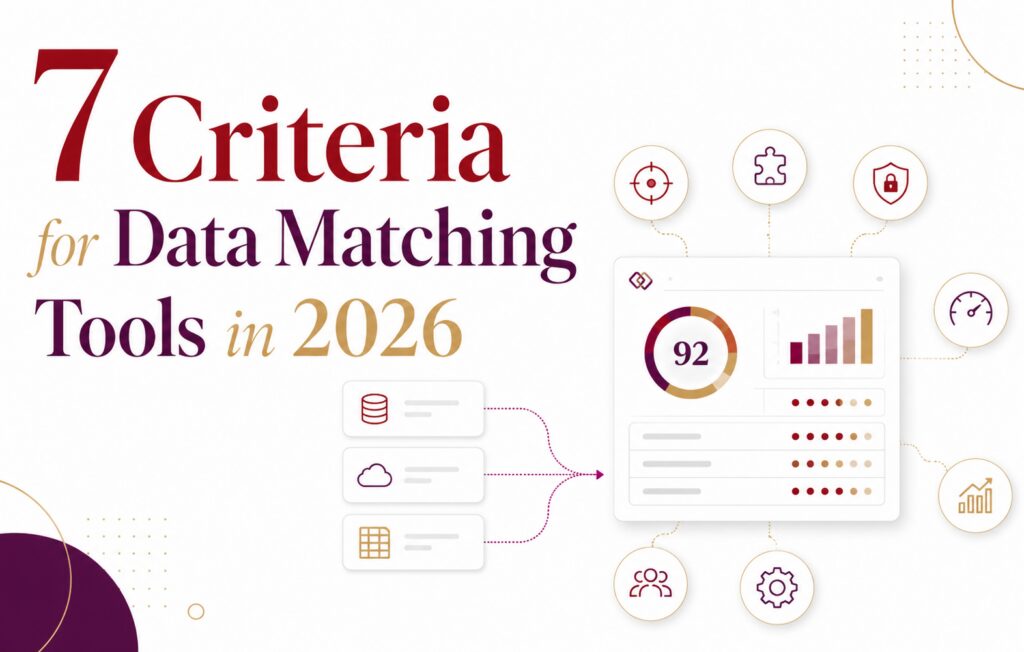
7 Criteria for Data Matching Tools in 2026
A data matching tool evaluation can easily become a feature-counting exercise. Vendor A supports more connectors. Vendor B says it…
Bad Data Is Costing You More Than You Think