

Angsuman Dutta
CTO, FirstEigen
Context-Aware Data Quality Rules: Why Data Quality Needs Judgment, Not Just Volume
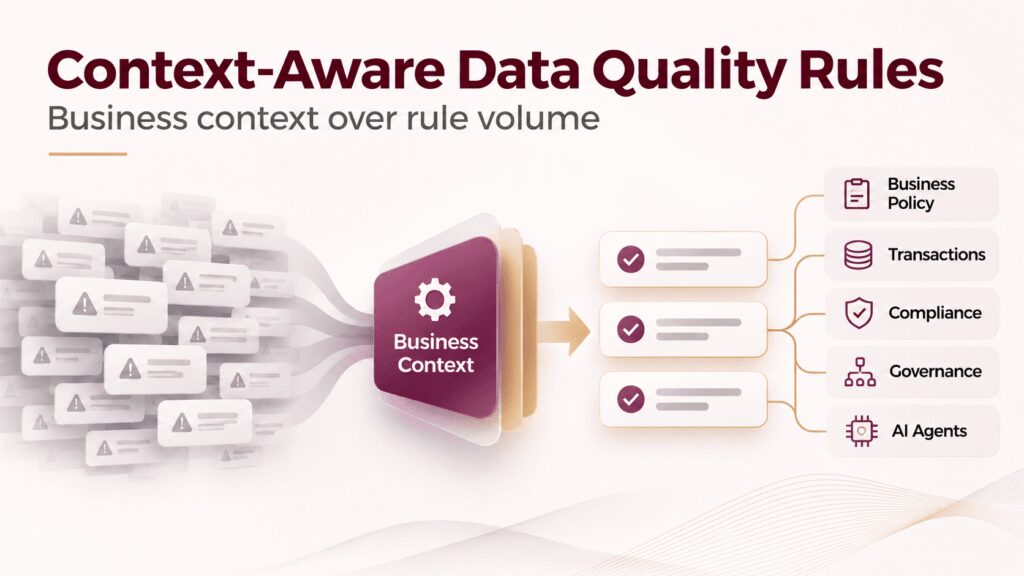
You can easily produce thousands of data quality rules using modern profiling tools but what makes them worth implementing? Your rules may be statistically valid but not make any business sense. You may have a dataset that passes all of your data quality rules but fails on a rule that has real importance to your finance, compliance, or customer requirements.
This new article from Dataversity explains why context-aware data quality rules are significant for every business:
Alert fatigue – Teams get fed up with receiving lots of low value alerts so decide not to implement any checks. One practitioner from a large insurance firm said that they needed an army to investigate these false alerts.
Misleading – Profiling doesn’t always give you the right information. Rules such as ‘amounts must be positive’ will fail due to refunds/reversals. Historical data can also cause issues with old errors being picked up. Some key rules won’t appear in a single field profile (such as checking loan balance consistency).
Business context – Field definitions, policies, regulations, and account relationships mean that these statistical anomalies now have a clear reason to be a control.
Measuring the right thing – Don’t measure how many rules you have. Instead, look at the precision and recall of your business rules, plus if your alerts are relevant.
AI agents – When your AI agent takes actions on your data without humans stopping to ask questions, having context-aware rules becomes very important.
The key point to take from this is that the future of data quality is having rules that make sense and are easy for a business owner to justify.
Read Full article: Context-Aware Rules: The Next Frontier for Data Quality Solutions
FAQs
Context-aware data quality rules are validation checks informed by business policies, data relationships, regulatory requirements, and operational context—not just statistical patterns. They help organizations identify meaningful data defects while reducing unnecessary alerts.

Discover How Fortune 500 Companies Use DataBuck to Cut Data Validation Costs by 50%

Enter your email address to access to downloads
Recent Posts
Context-Aware Data Quality Rules: Why Data Quality Needs Judgment, Not Just Volume
You can easily produce thousands of data quality rules using modern profiling tools but what makes them worth implementing? Your…
Teradata to BigQuery Migration: 230 Billion Records Reconciled
An enterprise data estate was modernized from Teradata to Google BigQuery. Record-level reconciliation replaced “it looks right” with evidence, and…
Why Data Quality Teams Need More Than Automated Rules
Great Expectations Killed Automated Rule Discovery. Here’s Why the Industry Got Rules Discovery Wrong. Auto-generating 100 rules in 60 seconds helped data…
Bad Data Is Costing You More Than You Think