Validate Cloud Warehouse Migrations Faster with Pushdown Matching on Databricks

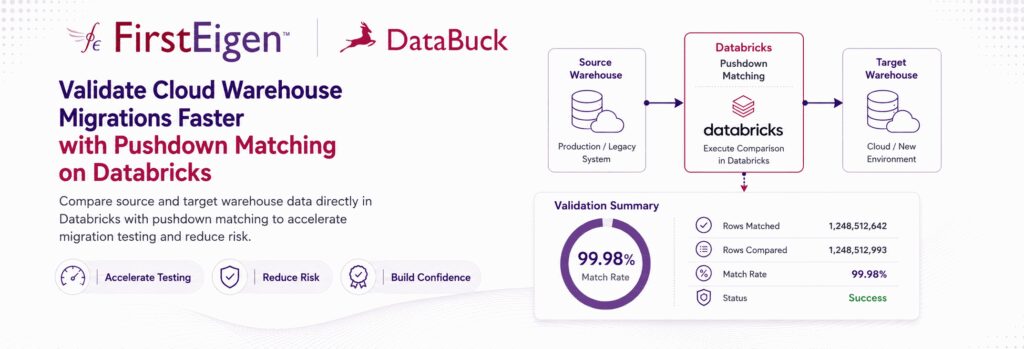
DataBuck extends its Data Matching module for Databricks so large-scale reconciliation runs where the data and compute already live—reducing data movement and accelerating validation sign-off.
June 29, 2026 – Naperville, IL, United States — FirstEigen today announced AI-powered Pushdown Data Matching for Databricks within DataBuck, expanding DataBuck’s Data Matching capabilities for enterprises validating cloud data warehouse migrations at scale. The release builds on DataBuck’s cross-platform reconciliation approach—already positioned for complex matching scenarios and broad platform support, including Databricks—by executing matching logic directly where the data and compute run.
Executive summary
- Migration validation that scales beyond sampling: Cloud migrations require evidence—record-level reconciliation and repeatable sign-off—especially across thousands of tables and large volumes.
- Pushdown matching on Databricks: Matching runs in-platform to reduce data movement and speed validation cycles for lakehouse-scale datasets.
- AI/ML-assisted matching to reduce manual effort: DataBuck’s matching is positioned as ML-powered and built to handle complex matching patterns used in enterprise reconciliation.
The migration challenge
Enterprise data migrations rarely fail because teams can’t copy data. They fail because teams can’t prove equivalence—across record counts, keys, transformations, and edge cases—within real cutover windows.
The most common failure mode is over-reliance on sampling and one-off SQL checks. Sampling can miss exactly the defects that matter most: rare mismatches, late-arriving deltas, key standardization issues, duplicate propagation, and transformation drift introduced as pipelines move to modern architectures. FirstEigen’s migration validation guidance emphasizes that sampling does not scale to large programs and does not produce audit-grade evidence for business and risk stakeholders.
For CIOs, CDOs, and cloud migration leads, the practical requirement is clear: validation must be repeatable, traceable, and fast enough to run for every wave—not only the “most important” tables.
Solution: AI-powered pushdown matching on Databricks
DataBuck’s Data Matching module is positioned to reconcile datasets across platforms—including Databricks—handling matching scenarios from straightforward field comparisons through complex relationship patterns used in enterprise reconciliation.
With pushdown matching on Databricks, DataBuck executes the reconciliation computation inside Databricks, where the tables and compute already live. In plain terms: instead of pulling large datasets out to compare elsewhere, the comparison runs in the same environment that is already governed, secured, and scaled for analytics workloads.
This matters because cloud migration validation is iterative. Teams re-run reconciliations as pipelines stabilize, mappings evolve, and incremental loads converge. Pushdown matching supports that iteration loop by reducing data movement and keeping validation closer to production-grade compute and governance controls already used by Databricks programs.
Key capabilities
- In-platform execution for Databricks: Matching runs where the data and compute operate, supporting faster iteration without extract-heavy workflows.
- Cross-platform reconciliation foundation: DataBuck Data Matching is positioned for reconciliation across multiple platforms and complex matching patterns.
- Support for modern + legacy stacks: FirstEigen states platform support including Databricks and other major cloud/on-prem systems.
- AI/ML-driven automation: DataBuck is positioned as AI/ML-powered, reducing manual effort in data validation workflows.
- Auditability-oriented outputs: FirstEigen case studies emphasize audit trail and executive visibility for validation outcomes.
- Designed for migration windows: Case studies highlight completing validations within operational windows by reducing runtime dramatically.
Enterprise success story
In a FirstEigen case study, a Fortune-100 technology company modernized a Teradata-based financial warehouse and needed to migrate thousands of tables and large volumes while maintaining reporting integrity. The company’s challenge was that traditional approaches were not scalable to validate hundreds of assets within the nightly processing window.
Using DataBuck, the organization reported:
- Daily validation time reduced from 11 hours to less than 2 hours, enabling validations to complete within the audit window.
- $1.7 million in savings attributed to the migration effort, along with reduced reporting risk and improved auditability (including dashboards and audit trails).
Pushdown matching for Databricks is designed to bring that same reconciliation discipline—fast, repeatable, audit-oriented matching—directly into Databricks-based migration programs, where large-scale validation must run continuously across waves.
Quotes
“Cloud migration success depends on evidence, not optimism—especially when you’re reconciling high-value reporting data across platforms,” said a FirstEigen executive. “Pushdown matching on Databricks keeps validation close to the data and compute teams already trust, while DataBuck’s ML-driven approach helps reduce the manual lift of reconciliation.”
“We needed validation that could finish inside real operational windows and hold up to audit scrutiny,” said a data platform stakeholder at a Fortune-100 technology manufacturer. “The outcomes were measurable—validation time dropped from 11 hours to under 2 hours—and the organization gained clearer visibility and traceability into the results.”
Availability + how to get started
AI-powered Pushdown Data Matching for Databricks is available as part of DataBuck’s Data Matching capabilities and Databricks integration services. To evaluate fit for your migration validation program, visit FirstEigen’s Databricks services page and DataBuck/Data Matching resources, or contact FirstEigen directly.
About FirstEigen
FirstEigen provides data quality, observability, trustability, and matching capabilities through DataBuck, supporting enterprise programs that require scalable validation across modern and legacy data platforms.
About DataBuck
DataBuck is positioned as an AI/ML-driven data validation platform, with modules including Data Matching, used for reconciliation and data trust workflows across platforms.