- Free Developer SDK
- Local rules
- DataFrame-native workflow
- Designed for portability
THE REVIEW LOOP
From DataFrame to approved rules in minutes
Let DataBuck recommend candidate rules from your data. Review the recommendations, save the approved rules in Git, and enforce them with DataBuck or your platform’s native validation engine.
Discover candidate rules
Analyze patterns, distributions, dependencies, cross-column relationships, and anomalous behavior.
rules = databuck.discover(df)
Review and version
Review each recommendation, its confidence, and the evidence behind it. Approve the rules your pipeline should enforce.
rules.review()
rules.save("orders_rules.yaml")
Enforce at the pipeline boundary
Validate with DataBuck or export approved rules to the framework already running your pipelines.
report = databuck.validate(df, rules)
report.assert_passed()
rules = databuck.discover(df)


rules.review()
rules.save("orders_rules.yaml")


report = databuck.validate(df, rules)
report.assert_passed()PIPELINE QUALITY GATE
Turn every critical DataFrame into a controlled quality gate
DataFrame + approved rule set
A bounded dataset and rules your team has reviewed.
Execute rules at the pipeline boundary
Run before the next material step in your pipeline.
Pass, quarantine, warn, retry, or stop
Apply the response your system and data product require.
Record failures, evidence, and rule-level results
Make every outcome useful to engineering and operations.
WHY DATABUCK
More than profiling. DataBuck discovers rules that reflect how your data should behave.
ENTERPRISE KNOWLEDGE RETRIEVAL
Discover rules from both the data and the business context
Data alone can reveal patterns, but it cannot always explain business intent. DataBuck combines observed DataFrame behavior with enterprise knowledge—including data contracts, catalog metadata, policies, table descriptions, and business documents—to recommend rules that are technically valid and operationally meaningful.
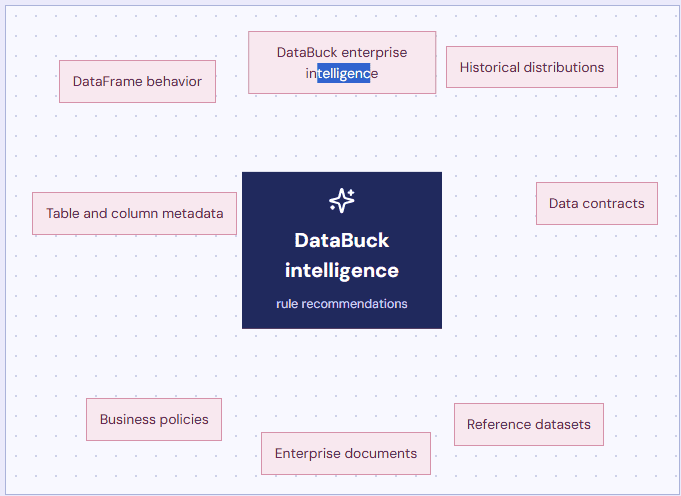
intelligence
DATABRICKS WORKFLOW
DataBuck discovers the rules. Databricks enforces them.
DataBuck analyzes Spark DataFrames, Unity Catalog metadata, data contracts, and enterprise policies to recommend data quality rules. Engineers review the recommendations and export approved rules as Lakeflow Expectations. Databricks remains the execution and orchestration platform.
review
Approved expectations move into your Databricks workflow as a visible, versioned artifact.
Reduce manual expectation authoring
Improve cross-column and conditional coverage
Standardize rules across data products
Store approved expectations in Git
Run validation using Databricks-native execution
One rule-discovery workflow across GCP data and AI pipelines
Use DataBuck to discover and review rules for BigQuery and Spark DataFrames, then enforce them at ingestion, transformation, model-training, or agent-consumption boundaries. Incorporate catalog metadata, contracts, policies, and business context without introducing another data movement layer.
Your rules remain visible, versioned, and portable
DataBuck rules are explicit artifacts—not hidden model behavior. Review them, store them in Git, compare changes through pull requests, and export them to supported validation frameworks. Your team controls which rules are approved and where they run.
Lakeflow Expectations
Python validation
SQL expressions
JSON/API representation
FRAMEWORK INTEGRATION PATTERNS
Validate data before an AI agent acts on it
Place a DataBuck quality gate between enterprise data retrieval and agent execution. Based on the validation result, your application can continue, retry the query, request human review, quarantine the result, or stop the workflow.
PREVIEW EDITION SCOPE · TWO EDITIONS, ONE ENGINEERING WORKFLOW
Start in code. Add organizational context when you need it.
FREE
DataBuck Developer SDK
Discover and validate data quality rules directly in Python. Keep rules and results in your development environment, review recommendations, store approved rules in Git, and export them to supported validation engines.
- Local rule discovery
- Local DataFrame validation
- Rule review and editing
- YAML/JSON rule storage
- Git-friendly versioning
- Supported native-framework exports
ENTERPRISE
DataBuck Enterprise SDK
Add enterprise context, centralized rule management, governed APIs, organizational standards, and DataBuck intelligence to the same developer workflow.
- Enterprise documents and policies
- Data contracts and catalog metadata
- Central rule repository
- DataBuck API integration
- DataBuck specialized models
- Approval and governance workflows
- Centralized results and observability
- Enterprise deployment and support
DATABUCK SDK — PRIVATE PREVIEW
Discover with DataBuck.
Review in code. Enforce anywhere.
DataBuck SDK is the context-aware rule discovery layer for modern data and AI pipelines. It analyzes DataFrames together with enterprise knowledge to recommend precise, reviewable data quality rules. Engineers approve and version the rules, then validate directly in Python or export them to native execution frameworks such as Databricks Lakeflow Expectations.