

Angsuman Dutta
CTO, FirstEigen
How to Evaluate Data Reconciliation Software in 2026
Search for “data reconciliation software,” and you can quickly encounter two very different categories of products.
One is designed primarily for finance teams reconciling bank accounts, ledgers, transactions, and the financial close.
The other is designed for data and technology teams trying to prove that information remained correct as it moved between databases, pipelines, cloud platforms, warehouses, and applications.
Those problems overlap conceptually, but the platforms used to solve them can be very different.
This guide is about the second category: enterprise data and pipeline reconciliation software. It explains how to evaluate data reconciliation software based on scale, automation, integrations, reconciliation methods, and operational requirements.
If you are first trying to establish where reconciliation belongs in your environment, start with our companion guide to 9 enterprise data reconciliation use cases.
What Data Reconciliation Software Actually Does
IBM defines data reconciliation as comparing and verifying information across systems to support data integrity, accuracy, and consistency.
Consider a simple migration.
Source table: 10,000,000 records
Target table: 9,997,423 records
The migration job reports success. The data does not reconcile.
But even equal row counts cannot prove correctness. Two tables might both contain 10 million records while some records are missing, others are duplicated, amounts changed, mappings shifted, or aggregates differ.
Enterprise reconciliation therefore operates at several levels. These data reconciliation techniques help teams validate data across schemas, records, fields, aggregates, and business rules.
Schema reconciliation
Do expected tables, columns, mappings, and data types exist?
Count reconciliation
Did the expected number of records move?
Aggregate reconciliation
Do totals, sums, averages, counts by group, and other business measures agree?
Record-level reconciliation
Does each expected source record have the correct counterpart?
Field or cell-level reconciliation
Do relevant source and target values agree for matched records?
Google’s Data Validation Tool is a useful technical example of layered source-to-target validation. It supports table-, column-, and row-level comparison patterns, including counts, aggregates, schema checks, hashes, exact comparisons, and custom queries across supported data sources.
Enterprise reconciliation software should ultimately help answer:
- Did everything expected arrive?
- Was anything unexpectedly changed?
- Can every material difference be explained?
Data Reconciliation vs. Data Matching vs. Data Validation – Where the Lines Blur
These categories are related but should not be collapsed into one. Understanding data reconciliation vs data validation is important when defining the right controls for an enterprise data environment.
Data matching
Matching determines which records correspond.
For example:
Source customer C1005 matches target customer 87022.
Data reconciliation
Reconciliation determines whether corresponding datasets or values agree.
For example:
Source customer balance: $125,000
Target customer balance: $124,500
That creates a reconciliation difference of $500.
Data validation
Validation checks whether data meets defined rules or criteria. IBM’s data validation overview describes techniques such as type, format, range, consistency, uniqueness, and other rule-based checks.
A value can therefore pass validation while failing reconciliation.
invoice_amount = 900 might be numeric, positive, and within an allowed range. It passes those validation rules. But if the authoritative source says invoice_amount = 90, the target still fails reconciliation.
The capabilities complement each other. For broader validation and monitoring, see FirstEigen’s DataBuck data quality platform.
The Two Markets Hiding Under One Search Term
This distinction is important enough to make before comparing products.
Financial close and accounting reconciliation platforms
Financial reconciliation tools are primarily designed around finance workflows.
Typical use cases include:
- bank reconciliation;
- account reconciliation;
- general-ledger reconciliation;
- intercompany reconciliation;
- transaction matching;
- financial close;
- journal and exception workflows.
The buyer may be a Controller, CFO organization, accounting team, or financial operations team.
These platforms can be highly sophisticated, but that does not automatically make them suitable for engineering-scale source-to-target data reconciliation.
Enterprise data and pipeline reconciliation platforms
Data reconciliation platforms for engineering teams address a different architecture.
Typical requirements include:
- cloud migration;
- warehouse migration;
- ETL/ELT validation;
- cross-platform consistency;
- mainframe modernization;
- lakehouse layer reconciliation;
- high-volume source-to-target comparison;
- pipeline verification.
The buyer is more likely to be a CTO, CDO, VP of Data Engineering, Head of Data Platform, or data architect.
The evaluation therefore needs to focus on data sources, transformations, scale, automation, root-cause analysis, and integration into data operations.
FirstEigen’s DataBuck Data Matching and Reconciliation solution falls into this second category: its public product description focuses on source/target tables, row- and cell-level reconciliation, migration validation, ETL/ELT pipelines, and multiple enterprise data platforms.
Evaluation Criteria for Enterprise Data Reconciliation Software
Automated, rule-based comparison across systems
Start with what can actually be compared.
A mature enterprise capability should go beyond COUNT(source) = COUNT(target). Modern data reconciliation software should automate repeatable comparison rules across source and target systems.
Useful checks may include:
- row counts;
- distinct keys;
- field values;
- sums;
- averages;
- minimum/maximum values;
- grouped aggregates;
- schema mappings;
- hashes;
- custom business queries.
Google’s Spanner data validation guidance explicitly recommends combinations of schema validation, row counts, sampled rows, aggregates, and row-level validation rather than relying on a single metric.
Ask the vendor:
- Can we compare different schemas?
- Can we reconcile transformed data?
- Can fields be mapped?
- Can we define tolerances?
- Can custom logic be expressed?
- Can reconciliation operate incrementally?
Exception handling and root-cause workflows
A reconciliation product is not useful simply because it says FAIL.
The value comes from determining why.
Consider a pipeline:
Source -> Bronze -> Silver -> Gold -> BI
A final revenue total is wrong.
A useful reconciliation architecture can identify:
- Source -> Bronze: pass
- Bronze -> Silver: pass
- Silver -> Gold: fail
- Gold -> BI: inherits the failure
That narrows the investigation to one boundary.
Within that boundary, users should ideally be able to move from a failed aggregate to an affected partition, then to mismatched records and mismatched fields.
Exception-management capabilities may include severity, owner, status, comments, resolution, approval, and history.
The objective is to reduce the distance between detection and explanation.
Scale and performance on high-volume data
Reconciliation can involve very large comparisons. Testing needs to reflect actual production volume and complexity.
Measure:
- data volume;
- number of tables;
- number of columns;
- number of rules;
- execution time;
- infrastructure consumption;
- incremental performance;
- concurrent jobs.
Consider architecture as well. Do comparisons require extracting data into another platform? Can computation run close to the data? Will source-system performance be affected?
FirstEigen’s Databricks cloud migration matching capability describes pushdown execution designed to run matching and reconciliation logic where the Databricks data and compute already reside.
For an example of the broader modernization problem, read Mainframe Data Reconciliation for Cloud Migration.
Audit trails and compliance reporting
Do not say a regulation “requires reconciliation software” unless it actually does.
For U.S. public-company financial reporting, PCAOB AS 2201 establishes requirements around audits of internal control over financial reporting and describes effective controls as providing reasonable assurance regarding reliable financial reporting. It does not prescribe a particular reconciliation product.
For banking, BCBS 239 establishes principles around risk data aggregation and reporting. Again, it does not tell banks to buy a named reconciliation tool.
In January 2026, the Basel Committee reiterated that accurate, comprehensive, and timely data aggregation and reporting are critical for identifying and managing material risks in financial institutions. This makes reconciliation and data-control evidence particularly relevant for regulated banking environments.
Where reconciliation forms part of a control framework, software can nevertheless help create evidence.
Evaluate:
- execution history;
- rule history;
- results;
- timestamps;
- exceptions;
- approvals;
- ownership;
- exportable evidence.
Integration with modern cloud data platforms
Map the actual environment before evaluating vendors.
Typical systems might include Databricks, Snowflake, BigQuery, Redshift, Oracle, SQL Server, PostgreSQL, Teradata, mainframe sources, object storage, dbt, and Airflow.
FirstEigen currently documents DataBuck connectivity across those categories, including cloud data platforms, databases, mainframe/legacy sources, orchestration tools, governance platforms, APIs, and webhooks.
Do not accept “supported” without clarification. Ask whether support means a native connector, JDBC/ODBC access, API, file export, pushdown execution, or custom integration. Those can create very different operating models.
Transformation-Aware Reconciliation
This should be a major evaluation criterion.
Imagine a source contains 100 million transactions while the target contains 500 aggregate records. Row-by-row equality is impossible because the transformation is intentional.
The software needs to validate the business relationship between source and target.
For example:
SUM(source.net_revenue WHERE region=’US’) = target.us_net_revenue
Or:
source rows = accepted target rows + quarantined rows + documented exclusions
This becomes particularly relevant in layered lakehouse architectures.
Databricks’ medallion architecture documentation describes Bronze as raw data, Silver as validated and refined data, and Gold as enriched data for analytics and business use. That creates natural reconciliation boundaries between layers.
For a FirstEigen implementation perspective, see Medallion Architecture reconciliation.
Continuous vs. One-Time Reconciliation
Another common evaluation mistake is choosing a tool based on a one-time migration when the long-term requirement is operational.
A migration may initially require source-to-target validation during cutover. After cutover, however, the organization may continue to need reconciliation across:
- daily batch pipelines;
- incremental feeds;
- finance and reporting processes;
- medallion layers;
- multi-cloud data movement;
- recurring regulatory or audit controls.
Ask whether the platform supports both one-time comparison and repeatable scheduled operation. Also test how configuration behaves when schemas, mappings, or business rules change.
A Practical Evaluation Framework: Questions to Ask Every Vendor
Matching and comparison
- Can you reconcile records when keys differ?
- How are source-target mappings created?
- Can you perform cell-level comparisons?
- Can you reconcile aggregates?
- Can you accommodate transformations?
- Can you define tolerances and acceptable variances?
Scale
- What production volumes have you tested?
- Where does computation execute?
- Can you run incremental checks?
- What performance impact will occur on source systems?
- How does cost change as volume and frequency increase?
Exceptions
- Can users drill from aggregate failure to individual records?
- Can exceptions be classified?
- Can owners be assigned?
- Can acceptable differences be approved?
- Can repeated exceptions be grouped or suppressed under a governed rule?
Governance
- Are rules versioned?
- Are execution results retained?
- Can we reconstruct an historical result?
- Can we export evidence?
- Can we see who approved an exception?
Integration
- How does the platform connect to our environment?
- Does it integrate with orchestration?
- Are APIs available?
- How are schema changes handled?
- What does “native support” mean in practice?
Security
- Where does data move?
- Where is data stored?
- What access controls exist?
- What deployment options are supported?
- Can sensitive columns be masked or excluded?
How to Run a Reconciliation Software Proof of Concept
Never evaluate only clean data.
Data reconciliation testing should use production-like volumes, transformations, mappings, exceptions, and seeded discrepancies.
Start with a real source-target workflow and deliberately introduce errors.
For example:
- remove 100 records;
- duplicate 50;
- modify 40 values;
- alter one transformation;
- change one column mapping;
- create one aggregate variance;
- add one expected tolerance case.
Then run the platform.
1. Detection
Did it find the seeded discrepancies?
2. Precision
Did it generate large numbers of irrelevant exceptions?
3. Localization
Could users identify the affected records and processing stage?
4. Performance
How long did processing take, and what resources were consumed?
5. Maintainability
What happens if a schema, mapping, source, or business rule changes?
6. Operationalization
Can the same reconciliation run on schedule, trigger alerts, retain evidence, and integrate into the team’s workflow after the POC?
A meaningful POC tests the complete operating loop, not just comparison logic.
Common Mistakes When Evaluating Reconciliation Tools
Choosing an accounting product for an engineering problem
Clarify the category first.
Testing only row counts
Equal counts do not prove equal data.
Ignoring transformations
Most enterprise pipelines intentionally change data.
Testing a tiny sample
A POC should represent production architecture and scale.
Ignoring investigation workflow
Detection without diagnosis simply creates another alert queue.
Assuming migration reconciliation is one-time
After cutover, source-target or pipeline controls may still be required as data continues to change.
Overstating compliance
Reconciliation may support an organization’s control framework. Using a particular tool does not by itself create regulatory compliance.
How DataBuck Supports Continuous, Automated Reconciliation
FirstEigen’s DataBuck data matching and reconciliation capability is publicly positioned around automated cross-platform reconciliation, including row-by-row and cell-by-cell comparison, schema and key matching, fuzzy matching, aggregate matching, and source-to-target validation.
FirstEigen also identifies cloud migration, ETL/ELT pipelines, financial and controlled reconciliation, and customer/MDM-style consistency among the current use cases for this capability.
DataBuck’s wider data quality platform adds automated validation, anomaly checks, custom SQL checks, referential checks, audit trails, and multiple deployment models.
A buyer should still verify every requirement through a POC. Product capability should be demonstrated against the exact data architecture being evaluated.
The Bottom Line
The strongest reconciliation platform is not the one that generates the most checks.
It is the one that can prove that important data remained correct as it moved through your environment – and help your team explain quickly when it did not.
FAQs
It compares corresponding information across systems or processing stages and identifies discrepancies in schemas, counts, records, fields, aggregates, or other defined business measures.

Discover How Fortune 500 Companies Use DataBuck to Cut Data Validation Costs by 50%

Enter your email address to access to downloads
Recent Posts
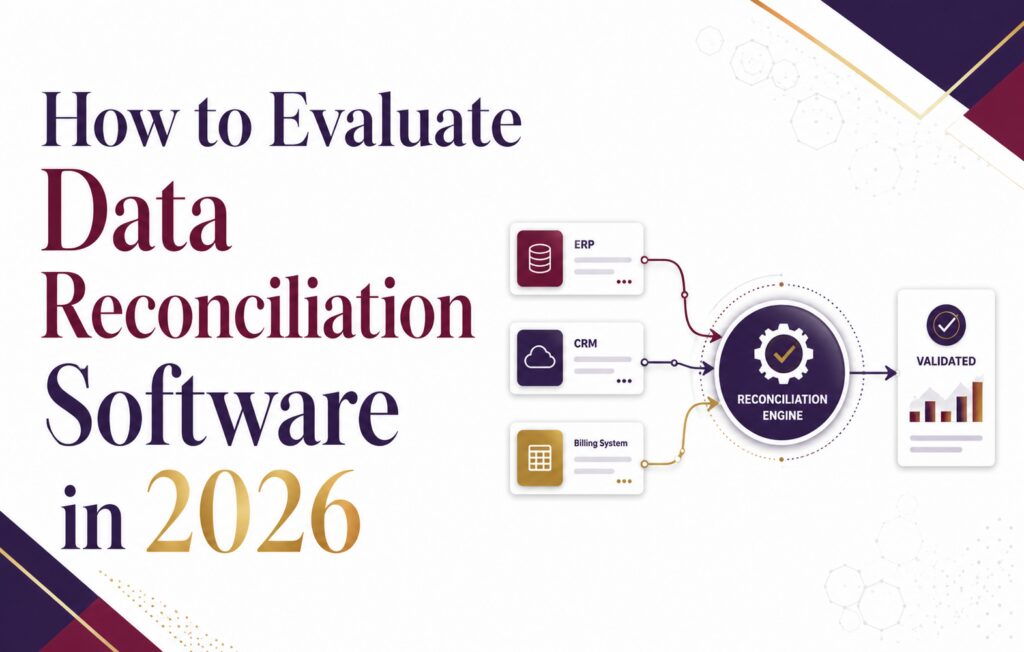
How to Evaluate Data Reconciliation Software in 2026
Search for “data reconciliation software,” and you can quickly encounter two very different categories of products. One is designed primarily for finance teams reconciling…
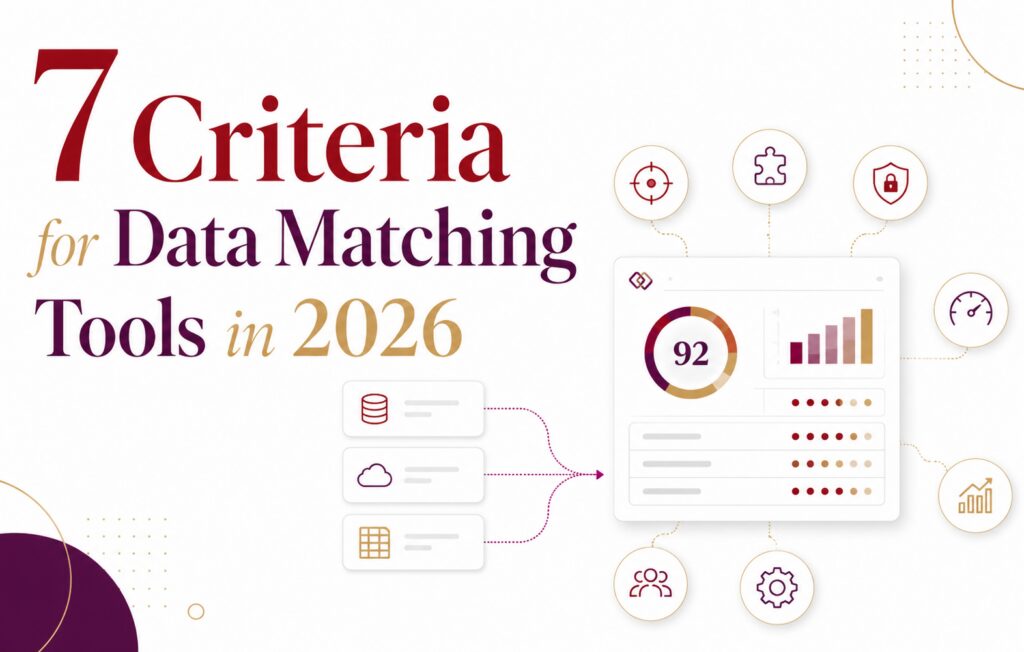
7 Criteria for Data Matching Tools in 2026
A data matching tool evaluation can easily become a feature-counting exercise. Vendor A supports more connectors. Vendor B says it…
Data Matching Software: A 2026 Buyer’s Guide
Choosing data matching software used to be relatively straightforward. A team had duplicate customer records, inconsistent supplier names, or two databases that needed…
Bad Data Is Costing You More Than You Think